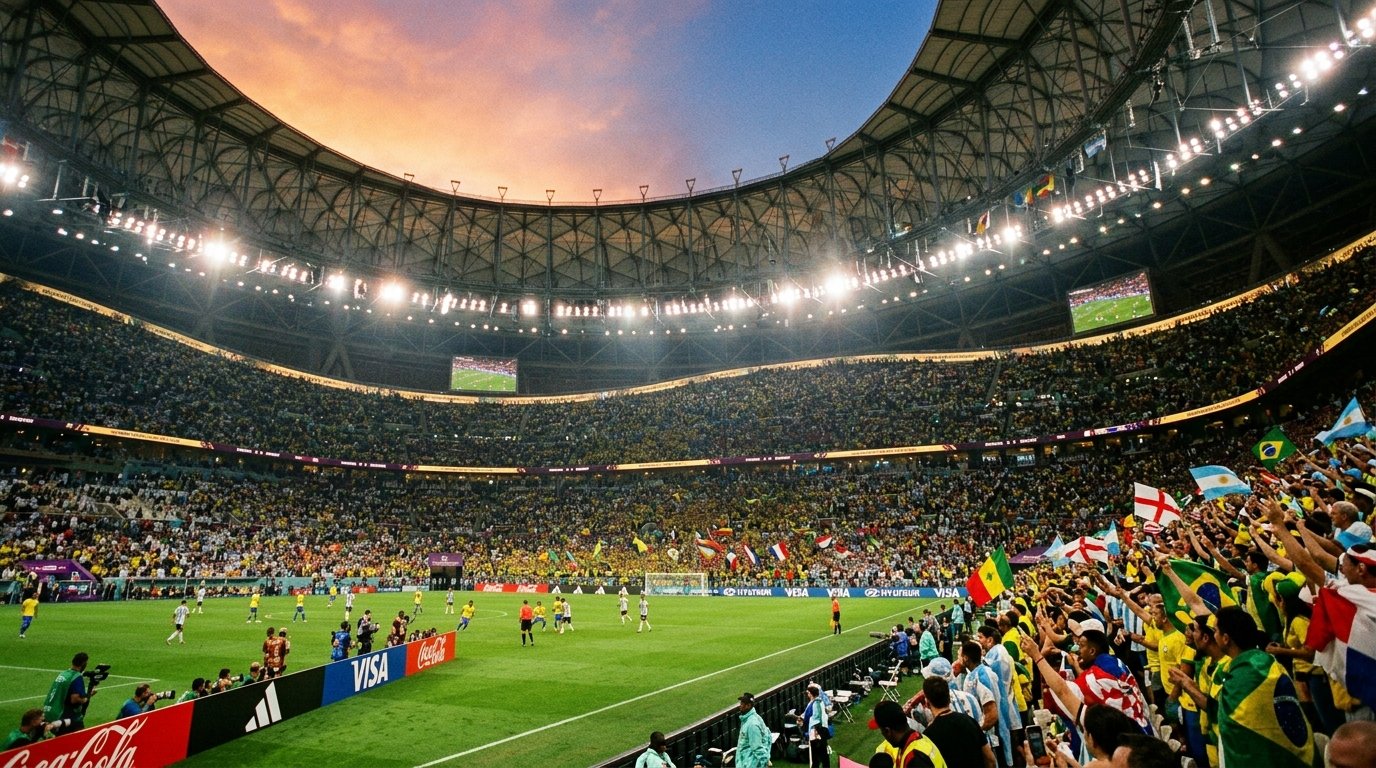
Inside the 2026 World Cup: Why This Is the Wildest Tournament FIFA Has Ever Run
If you've opened any sports app in the last few weeks and felt slightly lost, you're not alone. The 2026 FIFA World Cup looks bigger, louder, and messier than any World Cup before it, and that's not an exaggeration. It's a fact built into how the tournament was redesigned. Whether you've been glued to every match or you just keep seeing "World Cup 2026" trending and want to actually understand what's happening, this is the explainer that catches you up properly.
Let's start with the basics, because this year they matter more than usual.
Why This World Cup Is Different From Every Other One
For the first time in history, the FIFA World Cup 2026 isn't being hosted by one country. It's being shared across three: the United States, Canada, and Mexico. Matches are being played across sixteen host cities, with action stretching from the tournament's opening whistle on June 11 all the way to the final on July 19. FIFA
The bigger shake-up is the format itself. The tournament expanded from 32 teams to 48, the largest field in World Cup history, with 104 total matches. That's not a small tweak. It changes the entire rhythm of the competition. More teams means more group games, more underdog stories, and crucially, an extra knockout round that never existed before. LiveNOW from FOX

Here's where people usually get confused, so it's worth slowing down. After the group stage eliminated 16 teams, the remaining 32 moved into a brand-new Round of 32, a stage that simply didn't exist before this year's expansion. From there, the knockout stage runs in single elimination all the way through to the final, which will be held at MetLife Stadium in New Jersey. One loss, and a team is going home, no matter how good their group stage was. LiveNOW from FOXWikipedia
It's also why the scoring has been so absurd. The group stage alone produced 215 goals at a rate of 2.99 per match, the highest scoring rate of any World Cup since the 1950s. Part of that comes from the bigger field exposing weaker defenses to stronger attacks. Part of it, according to goalkeepers, comes down to the ball itself. Gulf News
The Ball Everyone's Talking About
This sounds like a minor detail until you hear it from the people actually trying to stop shots. Former England goalkeeper Joe Hart has said the new Adidas Trionda ball is proving difficult to handle because it travels flatter and with less spin than goalkeepers are used to, making it harder to read off the foot. For comparison, he pointed to the infamous Jabulani ball from the 2010 World Cup in South Africa, which was notoriously unpredictable but, in his words, an entirely different kind of problem. Gulf News
This matters for a reader who isn't a football obsessive, because it explains something you'll notice if you watch even one match: shots that seem to swerve unexpectedly, and goalkeepers who look genuinely unsettled. It's not bad goalkeeping. It's a new variable nobody's fully adjusted to yet.
Where the Knockout Stage Stands Right Now
As of this week, the tournament has officially entered business-end territory. The knockout stage runs from June 28 through July 19, and every match from here forward is win-or-go-home: 90 minutes, then 30 minutes of extra time if needed, then penalties if it's still level. Wikipedia
The opening result set the tone for how dramatic this stage can get. Stephen Eustáquio scored deep into stoppage time to give co-host Canada a 1-0 win over South Africa, sending Canada into the knockout rounds for the first time in their history. It was a fitting way to kick off a round where nothing is guaranteed and even host nations have to fight for every minute. france24

Beyond that single result, the bracket itself tells a bigger story. The Round of 16 field is made up of the 12 group winners, the 12 runners-up, and the eight best third-placed teams from the twelve groups, with a fixed bracket that doesn't allow for any redraws. That last detail matters more than it sounds. In past tournaments, fans sometimes complained about unlucky draws or perceived seeding advantages. This year, every team has known its exact potential path to the final since the group stage wrapped, for better or worse. CBSSports.com
A few notable storylines are already shaping up. Messi has pushed Argentina to the top of their group, England climbed to the top of theirs behind a Harry Kane goal, and Iran was eliminated. Meanwhile, the United States is set to face Bosnia and Herzegovina, with the winner advancing to face whoever comes out of Belgium versus Senegal. Al JazeeraCBSSports.com
The Golden Boot Race Is the Best Subplot of the Tournament
If you only follow one storyline through the rest of this World Cup, make it this one. The race for the Golden Boot, the award given to the tournament's top scorer, has turned into one of the most competitive in World Cup history.
Lionel Messi retook the lead during Argentina's win over Austria when he scored twice, the second of which made him the all-time leading scorer in World Cup history with 17 goals, overtaking Germany's Miroslav Klose. He didn't stop there. By the time the group stage wrapped, Messi had pushed his total to 18 goals, a number that surpasses even Brazil's Marta for the most goals scored by any player, male or female, in World Cup history. Yahoo SportsYahoo Sports
What makes this race genuinely gripping rather than a foregone conclusion is who's chasing him. Messi enters the knockout rounds with six goals in this tournament alone, just ahead of Kylian Mbappé, Ousmane Dembélé, Vinícius Júnior, and Erling Haaland, who all sit on four. Dembélé in particular announced himself in spectacular fashion. He scored a hat trick against Norway in the second-fastest treble in World Cup history, netting all three goals inside the first 32 minutes, with two of them assisted by Mbappé. Gulf NewsYahoo Sports
This is the part casual readers usually miss: a Golden Boot race isn't just about who scores most. It's also about who survives. A double-figure goal total has only happened three times in World Cup history, and the expanded 48-team format means there are simply more matches available for someone to reach it this year. Whoever wins the Golden Boot in 2026 may end up doing something genuinely unprecedented, not because they're better than past legends, but because the tournament itself has handed them more chances than anyone's ever had. Al Jazeera

There's also a quieter mechanic worth knowing if you want to actually follow the race properly: if two or more players finish tied on goals, FIFA uses assists as the tiebreaker, not just goals scored. That single rule has already shaped who's considered the favorite, since players like Vinícius Júnior have picked up ground on raw goal-scorers purely through assist totals. Yahoo Sports
What Happens From Here
The path forward is mapped out clearly, even if the results aren't. The Round of 16 runs from July 4 to July 7, with winners advancing to the quarterfinals under the same extra-time and penalty rules as every other knockout round. The two losing semifinalists will then meet in the third-place playoff on July 18 in Miami Gardens, the day before the final. LiveNOW from FOXLiveNOW from FOX
For a tournament that started with 48 teams and a brand-new ball nobody had fully figured out, the next three weeks are where everything gets settled: who lifts the trophy, who wins the Golden Boot, and whether this expanded format ends up remembered as a bold improvement or a one-time experiment.
Either way, this World Cup has already done something unusual. It's made the build-up to the final genuinely unpredictable, in a sport where the same handful of countries usually dominate the conversation by this point. That alone is worth paying attention to, whether you've watched every match or you're just catching up now.
Frequently Asked Questions
1. Why does the 2026 World Cup have three host countries instead of one?
This is the first World Cup ever shared across three nations, the United States, Canada, and Mexico, a decision tied to the tournament's expansion to 48 teams, which required far more stadiums and cities than any single country typically offers.
2. How many teams are competing, and how is that different from past World Cups?
This year features 48 teams, up from 32 in previous tournaments, which has added an entirely new Round of 32 knockout stage before the more familiar Round of 16 begins.
3. Who is currently leading the race for the World Cup Golden Boot?
Lionel Messi has led for most of the tournament, breaking the all-time World Cup goal-scoring record along the way, with Kylian Mbappé, Ousmane Dembélé, Vinícius Júnior, and Erling Haaland all closely chasing him into the knockout rounds.
4. What happens if a knockout match ends in a tie?
Tied knockout matches move to 30 minutes of extra time, and if the score is still level after that, the match is decided by a penalty shootout.
5. When is the World Cup final, and where will it be held?
The final is scheduled for July 19 at MetLife Stadium in East Rutherford, New Jersey, marking the end of a tournament that began on June 11.