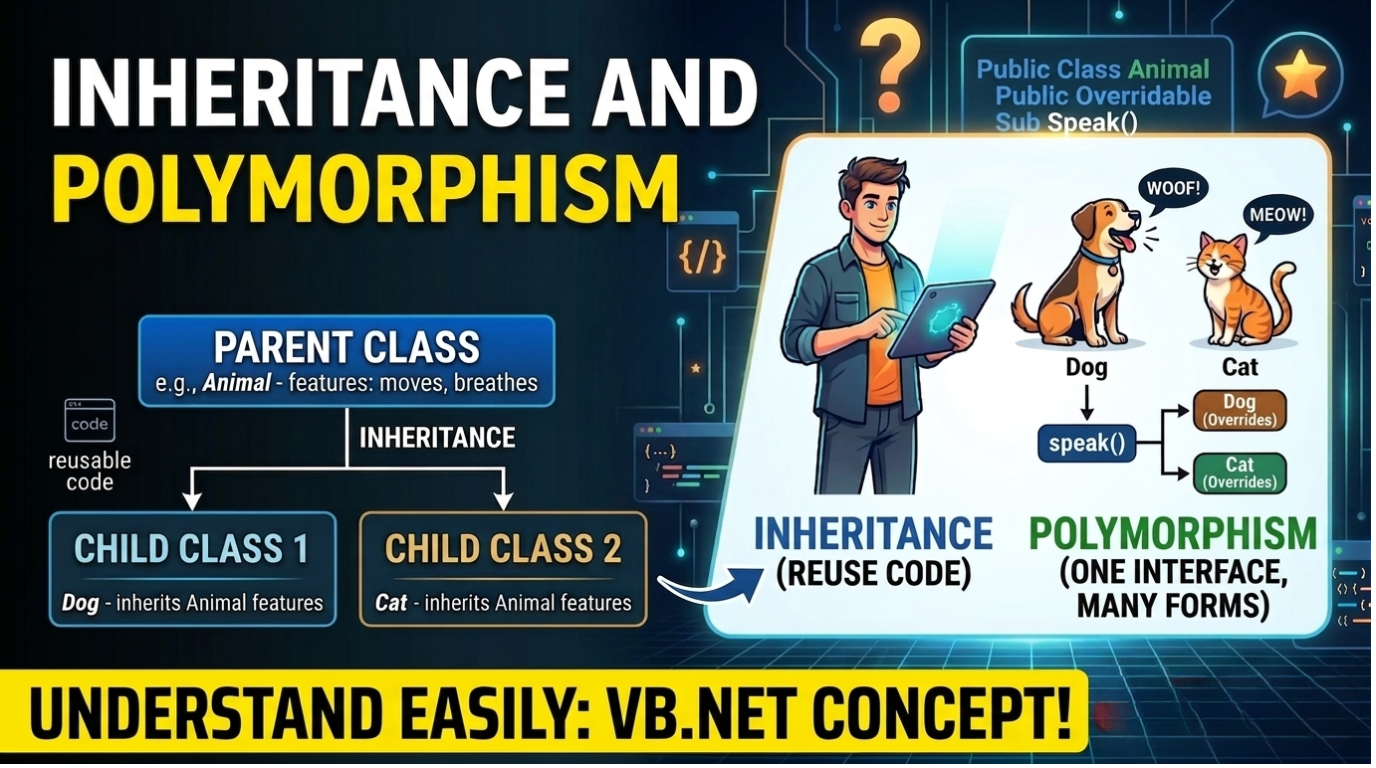
Inheritance
1.1 Definition
Inheritance allows a class (child/derived) to acquire properties and methods of another class (parent/base). It represents an IS-A relationship.
Real-world example: A Car IS-A Vehicle. A Student IS-A Person.
1.2 Syntax in VB.NET
' Parent class
Public Class ParentClass
    ' fields & methods
End Class

' Child class inherits from ParentClass
Public Class ChildClass
    Inherits ParentClass
    ' additional fields & methods
End Class
Key Point: VB.NET uses the Inherits keyword (unlike Java's extends or C#'s :).
1.3 Types of Inheritance

1.4 Important VB.NET Keywords

1.5 Access Modifiers in Inheritance

1.6 Constructor Behavior
- Parent class constructor executes before child class constructor
- Use
MyBase.New()to explicitly call parent constructor
Polymorphism
2.1 Definition
Polymorphism = "many forms". Same entity behaves differently in different contexts.
2.2 Two Main Types in VB.NET

2.3 Method Overloading Example
Public Class MathUtils
    Public Function Add(ByVal a As Integer, ByVal b As Integer) As Integer
        Return a + b
    End Function

    Public Function Add(ByVal a As Double, ByVal b As Double) As Double
        Return a + b
    End Function

    Public Function Add(ByVal a As Integer, ByVal b As Integer, ByVal c As Integer) As Integer
        Return a + b + c
    End Function
End Class
2.4 Method Overriding Example
Public Class Animal
    Public Overridable Sub MakeSound()
        Console.WriteLine("Animal makes sound")
    End Sub
End Class

Public Class Dog
    Inherits Animal
    Public Overrides Sub MakeSound()
        Console.WriteLine("Dog barks")
    End Sub
End Class
2.5 Shadows vs Overrides

Lab Activities: VB.NET Programs
Activity 1: Basic Single Inheritance
Problem: Create Employee (id, name, salary) and Manager (bonus). Calculate total pay.
' File: Employee.vb
Public Class Employee
    Public Property Id As Integer
    Public Property Name As String
    Public Property Salary As Double

    Public Sub New(ByVal id As Integer, ByVal name As String, ByVal salary As Double)
        Me.Id = id
        Me.Name = name
        Me.Salary = salary
    End Sub

    Public Overridable Sub Display()
        Console.WriteLine($"ID: {Id}, Name: {Name}, Salary: {Salary:C}")
    End Sub
End Class

' File: Manager.vb
Public Class Manager
    Inherits Employee

    Public Property Bonus As Double

    Public Sub New(ByVal id As Integer, ByVal name As String, ByVal salary As Double, ByVal bonus As Double)
        MyBase.New(id, name, salary)  ' Call parent constructor
        Me.Bonus = bonus
    End Sub

    Public Function TotalPay() As Double
        Return Salary + Bonus
    End Function

    Public Overrides Sub Display()
        MyBase.Display()
        Console.WriteLine($"Bonus: {Bonus:C}, Total Pay: {TotalPay():C}")
    End Sub
End Class

' File: Program.vb
Module Module1
    Sub Main()
        Dim mgr As New Manager(101, "Ali Ahmed", 50000, 10000)
        mgr.Display()
        Console.ReadLine()
    End Sub
End Module
Expected Output:
ID: 101, Name: Ali Ahmed, Salary: Rs.50,000.00
Bonus: Rs.10,000.00, Total Pay: Rs.60,000.00
Activity 2: Method Overriding with MyBase
Problem: Create BankAccount with CalculateInterest(). Override in SavingsAccount and CurrentAccount.
Public Class BankAccount
    Public Property Balance As Double

    Public Sub New(ByVal balance As Double)
        Me.Balance = balance
    End Sub

    Public Overridable Function CalculateInterest() As Double
        Return Balance * 0.03  ' 3% for normal account
    End Function
End Class

Public Class SavingsAccount
    Inherits BankAccount

    Public Sub New(ByVal balance As Double)
        MyBase.New(balance)
    End Sub

    Public Overrides Function CalculateInterest() As Double
        Return Balance * 0.05  ' 5% for savings
    End Function
End Class

Public Class CurrentAccount
    Inherits BankAccount

    Public Sub New(ByVal balance As Double)
        MyBase.New(balance)
    End Sub

    Public Overrides Function CalculateInterest() As Double
        Return Balance * 0.01  ' 1% for current
    End Function
End Class

' Test Module
Module BankTest
    Sub Main()
        Dim accounts() As BankAccount = {
            New SavingsAccount(10000),
            New CurrentAccount(10000)
        }

        For Each acc As BankAccount In accounts
            Console.WriteLine($"{acc.GetType().Name} Interest: {acc.CalculateInterest():C}")
        Next
        Console.ReadLine()
    End Sub
End Module
Expected Output:
SavingsAccount Interest: Rs.500.00
CurrentAccount Interest: Rs.100.00
Activity 3: Polymorphic Array (Abstract Class)
Problem: Create Shape abstract class with Area() method. Extend Circle and Rectangle. Store in array and calculate total area.
' Abstract class
Public MustInherit Class Shape
    Public MustOverride Function Area() As Double
End Class

Public Class Circle
    Inherits Shape

    Public Property Radius As Double

    Public Sub New(ByVal radius As Double)
        Me.Radius = radius
    End Sub

    Public Overrides Function Area() As Double
        Return Math.PI * Radius * Radius
    End Function
End Class

Public Class Rectangle
    Inherits Shape

    Public Property Length As Double
    Public Property Width As Double

    Public Sub New(ByVal length As Double, ByVal width As Double)
        Me.Length = length
        Me.Width = width
    End Sub

    Public Overrides Function Area() As Double
        Return Length * Width
    End Function
End Class

' Test Module
Module ShapeTest
    Sub Main()
        Dim shapes() As Shape = {
            New Circle(5),
            New Rectangle(4, 6)
        }

        Dim totalArea As Double = 0
        For Each s As Shape In shapes
            totalArea += s.Area()
        Next

        Console.WriteLine($"Total Area of all shapes: {totalArea:F2}")
        Console.ReadLine()
    End Sub
End Module
Expected Output:
Total Area of all shapes: 102.54
Activity 4: Constructor Chaining
Problem: Show order of constructor execution in inheritance chain.
Public Class A
    Public Sub New()
        Console.WriteLine("A's constructor called")
    End Sub
End Class

Public Class B
    Inherits A

    Public Sub New()
        MyBase.New()  ' Optional - called automatically
        Console.WriteLine("B's constructor called")
    End Sub
End Class

Public Class C
    Inherits B

    Public Sub New()
        ' MyBase.New() is automatically called
        Console.WriteLine("C's constructor called")
    End Sub
End Class

Module ConstructorTest
    Sub Main()
        Console.WriteLine("Creating object of C:")
        Dim obj As New C()
        Console.ReadLine()
    End Sub
End Module
Expected Output:
Creating object of C:
A's constructor called
B's constructor called
C's constructor called
Activity 5: Shadows Keyword Example
Problem: Demonstrate difference between Overrides and Shadows.
Public Class Parent
    Public Overridable Sub Show()
        Console.WriteLine("Parent Show method")
    End Sub
End Class

Public Class OverrideChild
    Inherits Parent
    Public Overrides Sub Show()
        Console.WriteLine("OverrideChild - Overridden method")
    End Sub
End Class

Public Class ShadowChild
    Inherits Parent
    Public Shadows Sub Show()
        Console.WriteLine("ShadowChild - Shadows method")
    End Sub
End Class

Module TestShadowVsOverride
    Sub Main()
        Dim p1 As Parent = New OverrideChild()
        Dim p2 As Parent = New ShadowChild()

        Console.WriteLine("Using Overrides:")
        p1.Show()  ' Calls overridden method

        Console.WriteLine("Using Shadows:")
        p2.Show()  ' Calls Parent method (polymorphism broken)

        Console.WriteLine("Direct call to ShadowChild:")
        Dim s As ShadowChild = New ShadowChild()
        s.Show()  ' Calls ShadowChild method

        Console.ReadLine()
    End Sub
End Module
Expected Output:
Using Overrides:
OverrideChild - Overridden method
Using Shadows:
Parent Show method
Direct call to ShadowChild:
ShadowChild - Shadows method
Activity 6: Interface Implementation (Alternative to Multiple Inheritance)
Problem: Create IPrintable interface and implement in multiple classes.
' Interface
Public Interface IPrintable
    Sub PrintDetails()
End Interface

' Base Class
Public Class Person
    Public Property Name As String
    Public Property Age As Integer

    Public Sub New(ByVal name As String, ByVal age As Integer)
        Me.Name = name
        Me.Age = age
    End Sub
End Class

' Multiple inheritance simulation using Interface
Public Class Student
    Inherits Person
    Implements IPrintable

    Public Property StudentID As String

    Public Sub New(ByVal name As String, ByVal age As Integer, ByVal studentID As String)
        MyBase.New(name, age)
        Me.StudentID = studentID
    End Sub

    Public Sub PrintDetails() Implements IPrintable.PrintDetails
        Console.WriteLine($"Student: {Name}, Age: {Age}, ID: {StudentID}")
    End Sub
End Class

Public Class Teacher
    Inherits Person
    Implements IPrintable

    Public Property EmployeeID As String

    Public Sub New(ByVal name As String, ByVal age As Integer, ByVal employeeID As String)
        MyBase.New(name, age)
        Me.EmployeeID = employeeID
    End Sub

    Public Sub PrintDetails() Implements IPrintable.PrintDetails
        Console.WriteLine($"Teacher: {Name}, Age: {Age}, Employee ID: {EmployeeID}")
    End Sub
End Class

Module InterfaceTest
    Sub Main()
        Dim printableItems As New List(Of IPrintable)
        printableItems.Add(New Student("Ahmed", 20, "S123"))
        printableItems.Add(New Teacher("Sara", 35, "T456"))

        For Each item As IPrintable In printableItems
            item.PrintDetails()
        Next
        Console.ReadLine()
    End Sub
End Module
Expected Output:
Student: Ahmed, Age: 20, ID: S123
Teacher: Sara, Age: 35, Employee ID: T456
Assignment / Lab Task (to be submitted)
Problem Statement: Library Management System
Design a system for a Library using VB.NET with the following requirements:
Requirements:
- Base Class
LibraryItemwith properties:
ItemID(Integer)Title(String)Year(Integer)IsAvailable(Boolean)
- Subclass
BookinheritsLibraryItemwith additional properties:
Author(String)Pages(Integer)
- Subclass
DVDinheritsLibraryItemwith additional properties:
Director(String)Duration(Integer) ' in minutes
- Methods:
GetDetails()- Overridable method in base class- Override
GetDetails()in both subclasses BorrowItem()- Marks item as unavailableReturnItem()- Marks item as available
- Polymorphic Method:
- vbnet
Public Sub PrintItemDetails(ByVal item As LibraryItem)
- Main Program:
- Create an array/list of 2 Books and 2 DVDs
- Print all items' details
- Borrow one book and one DVD
- Print details again to show availability change
Expected Output Format:
=== Library Catalog ===
[Available] Book: 101 - Visual Basic Programming (2021) by John Doe, 450 pages
[Available] DVD: 201 - Inception (2010) directed by Nolan, 148 min
...

=== After Borrowing ===
[Borrowed] Book: 101 - Visual Basic Programming (2021) by John Doe, 450 pages
...