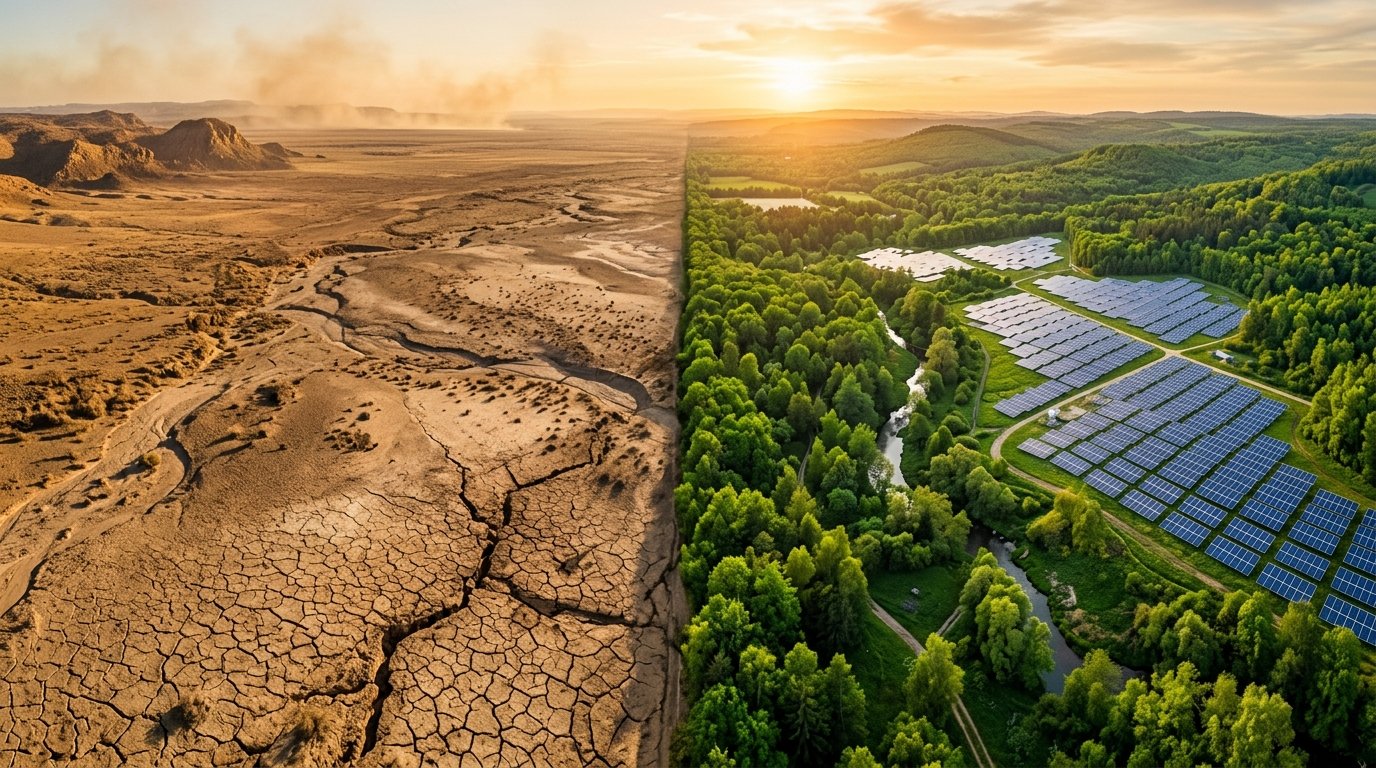
The last three years, 2023 through 2025, are the three hottest years ever recorded in human history. Not in a decade. Not in a century. Ever.
Most people assume climate change is a slow, distant threat. Something scientists track on graphs, governments debate in conference rooms, and the next generation deals with. That assumption is costing us time we do not have.
The Planet Is Warming Faster Than Models Predicted
Scientists built climate models to project what would happen if we kept burning fossil fuels at scale. The real world is outpacing those projections. Global warming is edging closer to the 1.5 degree Celsius warming limit set by the 2015 Paris Agreement, a threshold climate scientists view as critical for avoiding the worst consequences of human-amplified climate change. ABC News
The problem is not just that temperatures are rising. It is that they are rising faster than our systems can adapt.
Atmospheric greenhouse gases have steadily increased over the last 10 years, and human activity remains the dominant driver of the exceptional temperatures now being observed. Every year of inaction does not just maintain the problem. It makes it exponentially harder to reverse. ABC News
Why Fossil Fuels Are Still the Core Driver
Burning coal, oil, and natural gas releases carbon dioxide and methane into the atmosphere. These gases trap heat like a blanket around the Earth. The more we emit, the thicker that blanket becomes.
Carbon pollution from fossil fuels made record heat, hurricanes, fires, and floods worse in 2025, disrupting lives across the United States and beyond. The Los Angeles wildfires alone caused over $250 billion in damage. These are not random weather events. They are the predictable results of a warming planet. Climate Central
The Hidden Mechanism Making Everything Worse
Here is what most people miss: climate change does not just add problems. It multiplies them through feedback loops.
As temperatures rise, Arctic ice melts, exposing darker ocean water that absorbs more sunlight and causes further warming. Less ice means more heat absorbed. More heat means less ice. The cycle accelerates on its own. Science Times
Global warming triggers shifts in the environment that release more greenhouse gases into the atmosphere, leading to a cycle of more warming and even more gases being released. This is not a linear problem. It is a compounding one. Council on Foreign Relations
The Line You Cannot Uncross
Climate tipping points are thresholds beyond which a part of the climate system shifts into a new state that is difficult or impossible to reverse on human timescales. After a tipping point is crossed, the system may continue changing even if greenhouse gas emissions are reduced, because internal feedback loops keep driving the shift. Science Times
Several of these tipping points are already dangerously close.
The Greenland and West Antarctic ice sheets may be passing tipping points, potentially committing the planet to meters of sea level rise. Ocean heat content has reached a record high, contributing to the largest coral bleaching event ever recorded, affecting 84% of reef area. Oxford AcademicOxford Academic
Once these systems collapse, no policy reversal brings them back.
Deforestation Is Accelerating the Problem
Forests absorb carbon. When we burn or clear them, they release it instead. Global fire-related tree cover loss reached an all-time high in 2025, with fires in tropical primary forest up 370% over 2023, fueling rising emissions and biodiversity loss. Oxford Academic
The Amazon, which has long acted as one of the planet's most important carbon sinks, is now in many areas releasing more carbon than it absorbs. We are eliminating our natural defenses at the exact moment we need them most.
What Can Actually Be Done
The situation is serious. It is not hopeless. The same science that identifies the problem also points toward the solution.
The amount of global warming we get is proportional to the amount of carbon emissions, so to reduce the warming and its consequences, we need to cut emissions. Every year of delay locks in higher risks and costs. Live Science
At the government level, that means accelerating the transition from fossil fuels to renewable energy, enforcing reforestation commitments, and holding corporations accountable for emissions targets. At the individual level, it means making choices that reduce personal carbon footprints: eating less meat, flying less, supporting clean energy policies, and electing leaders who treat climate science as non-negotiable.
The Transition to Clean Energy Is Already Underway
Solar and wind energy are now the cheapest sources of new electricity generation in most of the world. Electric vehicles are outselling combustion engine cars in multiple major markets. The technology exists. The question is whether the political and economic will can keep pace with the urgency.
Every rooftop solar panel, every plant-based meal, every vote for strong environmental legislation is a measurable reduction in warming. None of these actions alone saves the planet. Together, scaled across billions of people, they determine which side of the tipping point we land on.
The Window Is Narrow but Open
Climate change is getting worse because of accumulated decades of high emissions, deforestation, and feedback loops now reinforcing each other. But the science is equally clear that slowing emissions today still matters enormously. The difference between 1.5 degrees and 2 degrees of warming is not just a number. It is hundreds of millions of people's access to food, water, and livable land.
The worst outcomes are not inevitable. But they become more inevitable with every year we treat this as someone else's problem.
Frequently Asked Questions
Why is climate change accelerating instead of slowing down?
Cumulative greenhouse gas emissions have built up in the atmosphere over decades, and feedback loops like Arctic ice melt are now amplifying warming on their own. Emissions reductions must be faster than current trends to offset this acceleration.
What is the most dangerous tipping point in climate change?
The melting of the Greenland and West Antarctic ice sheets is widely considered among the most dangerous, as their collapse would commit the planet to several meters of sea level rise that cannot be reversed even if emissions stop.
Can individual actions really make a difference in climate change?
Yes, especially at scale. Reducing meat consumption, using renewable energy, and supporting climate-conscious policies each carry measurable carbon impact. Individual action also drives market signals and political pressure that shape systemic change.
What happens if global warming exceeds 1.5 degrees Celsius?
Beyond 1.5 degrees, extreme heat events become far more frequent, coral reef systems largely collapse, food and water insecurity intensifies globally, and more climate tipping points come within reach, making the situation harder to stabilize.
Is it too late to stop climate change?
It is too late to prevent all impacts, but not too late to prevent the worst ones. Every fraction of a degree of warming avoided matters. The actions taken in this decade will determine the severity of climate conditions for centuries.