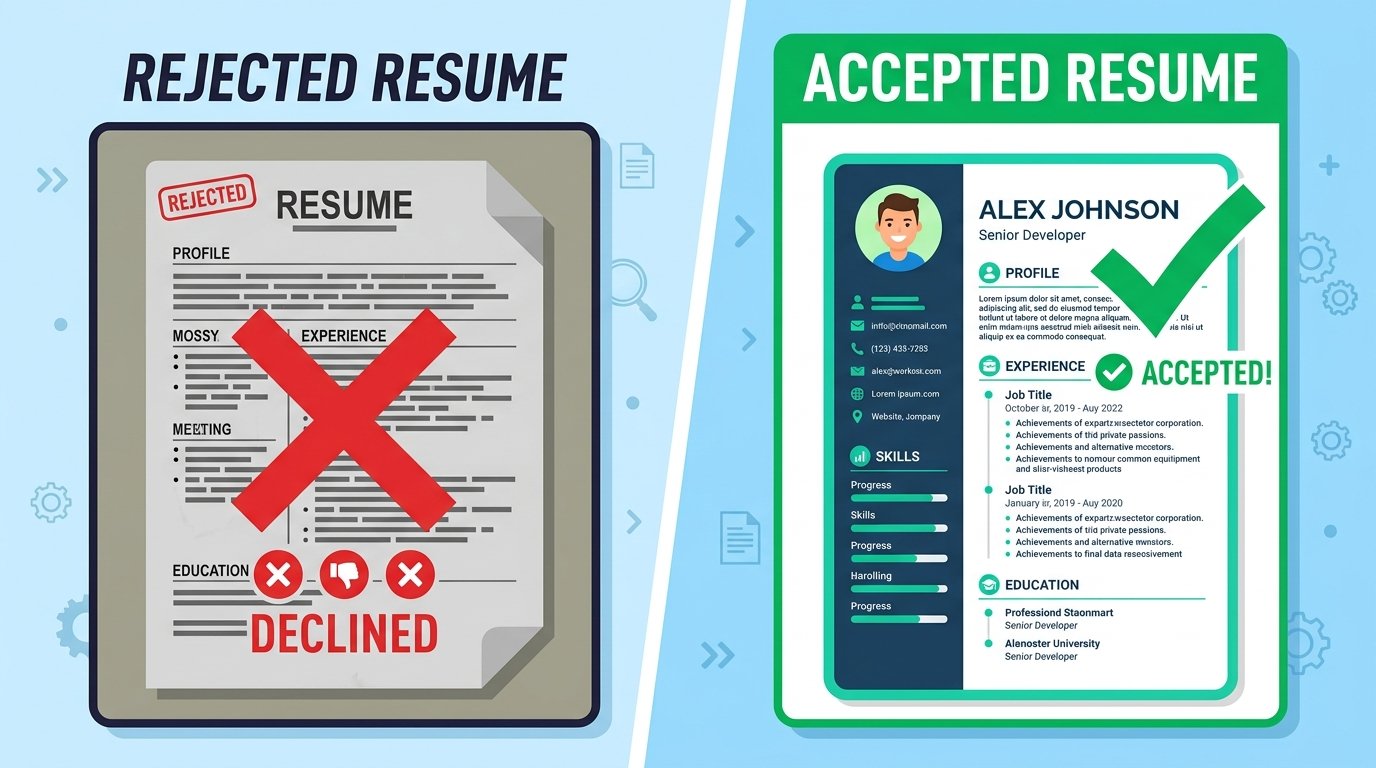
Recruiters spend an average of six to seven seconds scanning a resume before deciding whether to read further or move on.
You spent hours writing yours. They spent seconds dismissing it. That gap is the problem most job seekers never fix.
Your Resume Is Competing Against a Machine First
Before a human being ever reads your resume, a software program called an Applicant Tracking System has already judged it. Nearly 97.8 percent of Fortune 500 companies use an ATS to filter incoming applications. The average unoptimized resume is missing 52 percent of the keywords found in its target job description. That means more than half of applicants are eliminated before a recruiter opens a single file. High 5 TestResumeAdapter
The fix is not to write more. It is to write smarter.
Pull up the job description. Identify the words and phrases that appear more than once. Those are the keywords the ATS is scanning for. Work them naturally into your resume summary, your skills section, and your bullet points. Match the exact phrasing used in the job posting, including job titles, hard skills, certifications, and tools. Jobscan
Lead With a Summary That Does the Selling Immediately
Most people open their resume with a bland objective statement. Recruiters skip it instantly.
Replace it with a three-to-four line professional summary that answers one question: why should this company hire you over everyone else? Use that space to highlight your particular skill set, professional background, and career goals rather than a generic heading. Write something like "Results-driven marketing manager with eight years of experience scaling B2B campaigns to seven-figure revenue" and you have earned the next ten seconds of their attention. berkeley
Your summary is your headline. Treat it like one.
Quantify Everything You Possibly Can
Vague claims are resume killers. Phrases like "responsible for managing a team" or "helped increase sales" tell a recruiter nothing they can act on.
Numbers do the work that words cannot. Quantify your achievements using specific metrics whenever possible to demonstrate the actual impact of your work. "Managed a team" becomes "Led a team of twelve that reduced customer churn by 34 percent in two quarters." The first version gets ignored. The second version gets an interview. ResumeGemini
Go back through every bullet point you have written. Ask yourself: what was the result, and can I put a number on it? More often than not, the answer is yes.
Format for the Six-Second Scan, Not the Full Read
Hiring managers only scan a resume for a handful of seconds before moving on to the next one, and a simpler design makes it far easier for them to find the most important information. coursera
That means no decorative graphics, no unusual fonts, no columns that break the ATS parsing logic. Use standard section headers such as Experience, Skills, and Education. Keep your font clean and readable. Bold your job titles. Use bullet points that start with strong action verbs. Avoid complex formatting elements like tables, images, and graphics since ATS systems struggle to parse them. ResumeGemini
One page is ideal for anyone under ten years of experience. Two pages is the hard ceiling.
Tailor Every Single Application
The biggest mistake job seekers make is sending the same resume to fifty different companies.
Tailoring your resume to each specific job application increases your chances of getting noticed by potential employers. Read the job description carefully, highlight relevant skills and experience, and use similar language to that used in the posting. This takes an extra twenty minutes per application. It also triples your callback rate. ResumeGemini
Keep a master resume with all of your experience and achievements. Then create a targeted version for each role, cutting what is not relevant and elevating what directly matches.
The Skills Section Is Not a Checklist, It Is a Strategy
Most people dump a random list of tools and traits at the bottom of their resume and call it a skills section.
That section is prime real estate. Fill it with the exact hard skills mentioned in the job description. Include relevant certifications, software, platforms, and industry-specific tools. With 64.8 percent of employers now using skills-based hiring practices, highlighting evidence of job-ready skills and real accomplishments matters more than ever. High 5 Test
Soft skills like "team player" and "excellent communicator" add no value without context. Show those through your bullet points, not a list.
Polish Is Not Optional
A typo on a resume signals carelessness. One grammatical error can be the reason a recruiter puts your application in the rejection pile.
Do not rely on spell check and grammar check alone. Step away from your resume for a few hours, read it again with fresh eyes, and have a trusted person review it before you submit. Save and send it as a PDF unless the employer specifically requests a Word document. A PDF preserves your formatting across every device and every operating system. The Muse
Your resume is not a history of where you have been. It is a pitch for where you are going. Write it like one, optimize it for the systems that gate it, and make every word earn its place on the page.
Frequently Asked Questions
Q1: How long should a resume be in 2026?
For most professionals with under ten years of experience, one page is ideal. Those with extensive experience across multiple roles can use two pages. Anything beyond two pages will typically be ignored.
Q2: What is the most important section of a resume?
The professional summary at the top carries the most weight because it sets the tone in the first few seconds. If it does not immediately communicate your value, the recruiter may not read further.
Q3: How do I make my resume ATS-friendly?
Use standard section headers, clean fonts, no tables or graphics, and include exact keywords from the job description. Save the file as a PDF or Word document for maximum compatibility.
Q4: Should I customize my resume for every job?
Yes, every time. A tailored resume that mirrors the language and priorities of the job description consistently outperforms a generic one. Keep a master resume and edit it down for each application.
Q5: How do I show achievements if my role is hard to quantify?
Look for any metric you can attach to your work. Response times, number of clients handled, events organized, processes improved, or team size managed all count. If a number is genuinely unavailable, describe the specific outcome your work produced.