Introduction (Understanding the Concept)
What is Minimum Edit Distance?
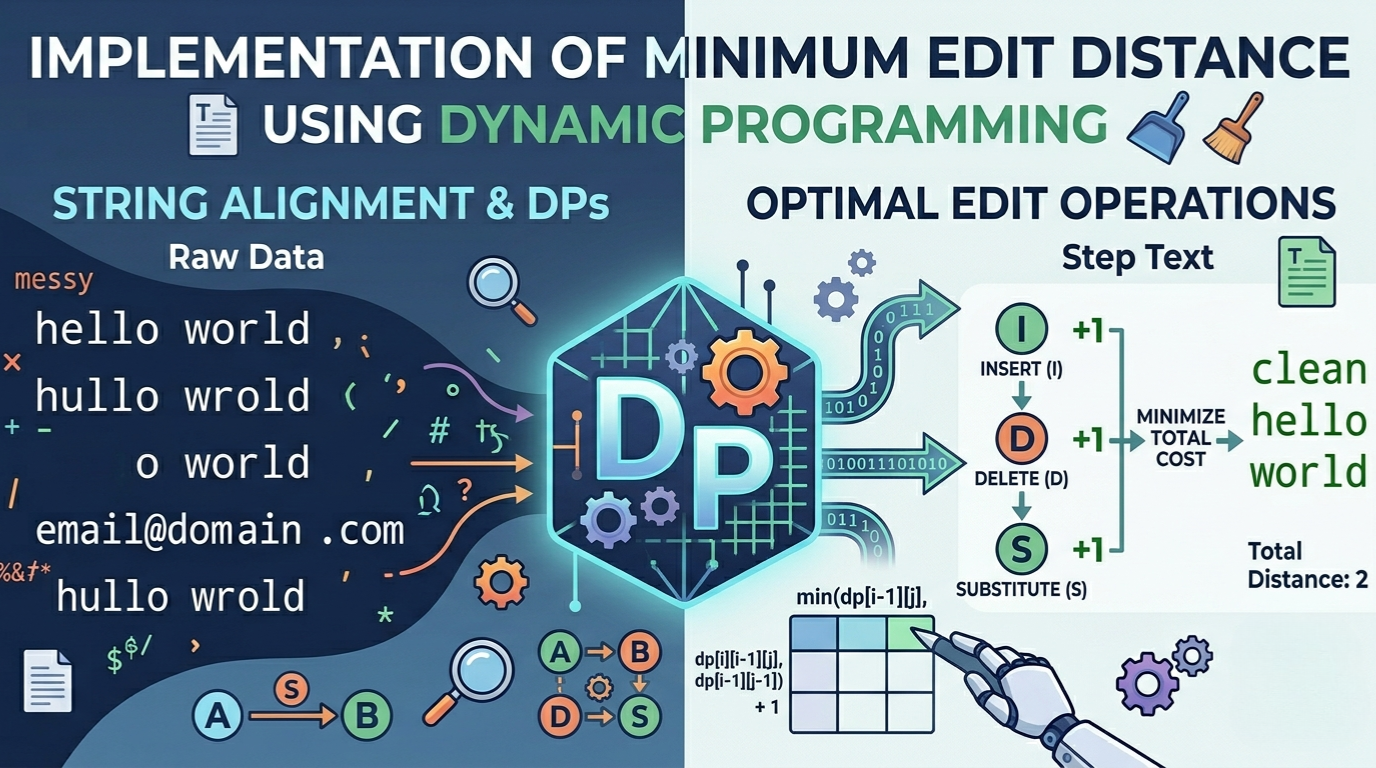
In simple words: A mathematical way to measure the "difference" between two strings by counting the minimum number of operations needed to transform one string into another.
Example:
String A = "CAT"
String B = "CAR"
Difference? Only one letter (T → R). Therefore distance = 1
How Do We Measure It?
Three operations are allowed (each operation typically costs 1):

Real-Life Applications

What Will You Learn in This Lab?
- Understanding the edit distance formula and DP table
- Implementing from scratch in Python
- Backtracing to find which operations were used
- Building a real spelling corrector
- Customizing costs for different applications
Visual Example: "CAT" → "CAR"
Step-by-step visualization:

Method 1 (Optimal):
CAT
 │
 └─> Substitute 'T' with 'R'
     │
     CAR
Distance = 1 (only one operation)

Method 2 (Not optimal):
CAT → CA (delete 'T') → CAR (insert 'R')
Distance = 2 (two operations)

Method 3 (Not optimal):
CAT → CART (insert 'R') → CAR (delete 'T')
Distance = 2 (two operations)
Practical Lab (Step-by-Step)
Step 1: Understanding the DP Table Manually
Strings: "CAT" (source) → "CAR" (target)
Table Size: (len(src)+1) × (len(target)+1) = 4 × 4
Rules:
- Row 0, Column 0 = 0
- Row 0, Column j = j (need j insertions to reach target)
- Column 0, Row i = i (need i deletions from source)
The Recurrence Formula:
D[i][j] = minimum of:
    D[i-1][j] + 1     # Delete from source
    D[i][j-1] + 1     # Insert into source
    D[i-1][j-1] + cost # Substitute (0 if same, 1 if different)
Initialize the table:
     ''  C   A   R
''    0   1   2   3
C     1   ?   ?   ?
A     2   ?   ?   ?
T     3   ?   ?   ?
Fill Cell (1,1): Compare 'C' (source) with 'C' (target) → Same character
Delete: D[0][1] + 1 = 1 + 1 = 2
Insert: D[1][0] + 1 = 1 + 1 = 2
Substitute: D[0][0] + 0 = 0 + 0 = 0
Minimum = 0
Updated table:
     ''  C   A   R
''    0   1   2   3
C     1   0   ?   ?
A     2   ?   ?   ?
T     3   ?   ?   ?
Fill Cell (1,2): Compare 'C' (source) with 'A' (target) → Different
Delete: D[0][2] + 1 = 2 + 1 = 3
Insert: D[1][1] + 1 = 0 + 1 = 1
Substitute: D[0][1] + 1 = 1 + 1 = 2
Minimum = 1
Continue filling all cells...
Final completed table:
     ''  C   A   R
''    0   1   2   3
C     1   0   1   2
A     2   1   0   1
T     3   2   1   1
Answer: Bottom-right cell (3,3) = 1
So the minimum edit distance from "CAT" to "CAR" is 1.
Step 2: Python Implementation (Simple Version)
def min_edit_distance(src, target):
    """
    Calculate minimum edit distance between src and target
    Default costs: insertion=1, deletion=1, substitution=1

    Args:
        src: Source string
        target: Target string

    Returns:
        int: Minimum edit distance
    """
    n, m = len(src), len(target)

    # Create DP table with zeros
    dp = [[0] * (m + 1) for _ in range(n + 1)]

    # Initialize base cases
    for i in range(n + 1):
        dp[i][0] = i  # Delete all characters from src
    for j in range(m + 1):
        dp[0][j] = j  # Insert all characters into src

    # Fill the table using the recurrence relation
    for i in range(1, n + 1):
        for j in range(1, m + 1):
            if src[i-1] == target[j-1]:
                cost = 0  # Same character, no substitution needed
            else:
                cost = 1  # Different character, need substitution

            dp[i][j] = min(
                dp[i-1][j] + 1,      # Deletion
                dp[i][j-1] + 1,      # Insertion
                dp[i-1][j-1] + cost  # Substitution
            )

    # Print the DP table for understanding (optional)
    print("\nDP Table:")
    print("    ", "  ".join([''] + list(target)))
    for i in range(n + 1):
        if i == 0:
            print(f"   {dp[i]}")
        else:
            print(f"{src[i-1]}  {dp[i]}")

    return dp[n][m]

# Test the function
print("=" * 50)
print("Testing 'CAT' → 'CAR':")
dist = min_edit_distance("CAT", "CAR")
print(f"\nMinimum Edit Distance: {dist}")

print("\n" + "=" * 50)
print("Testing 'kitten' → 'sitting':")
dist = min_edit_distance("kitten", "sitting")
print(f"\nMinimum Edit Distance: {dist}")
Step 3: Backtrace to Show Operations
def edit_distance_with_operations(src, target):
    """
    Calculate edit distance AND show the sequence of operations

    Args:
        src: Source string
        target: Target string

    Returns:
        tuple: (distance, list_of_operations)
    """
    n, m = len(src), len(target)
    dp = [[0] * (m + 1) for _ in range(n + 1)]

    # Initialize
    for i in range(n + 1):
        dp[i][0] = i
    for j in range(m + 1):
        dp[0][j] = j

    # Store which operation gave the minimum value
    ops = [[''] * (m + 1) for _ in range(n + 1)]

    # Fill the table
    for i in range(1, n + 1):
        for j in range(1, m + 1):
            if src[i-1] == target[j-1]:
                dp[i][j] = dp[i-1][j-1]
                ops[i][j] = 'M'  # Match (keep character)
            else:
                # Try all three operations
                delete_cost = dp[i-1][j] + 1
                insert_cost = dp[i][j-1] + 1
                substitute_cost = dp[i-1][j-1] + 1

                if delete_cost <= insert_cost and delete_cost <= substitute_cost:
                    dp[i][j] = delete_cost
                    ops[i][j] = 'D'  # Delete
                elif insert_cost <= delete_cost and insert_cost <= substitute_cost:
                    dp[i][j] = insert_cost
                    ops[i][j] = 'I'  # Insert
                else:
                    dp[i][j] = substitute_cost
                    ops[i][j] = 'S'  # Substitute

    # Backtrace to find the sequence of operations
    i, j = n, m
    sequence = []
    while i > 0 or j > 0:
        if i > 0 and j > 0 and ops[i][j] == 'M':
            sequence.append(f"Keep '{src[i-1]}'")
            i -= 1
            j -= 1
        elif i > 0 and j > 0 and ops[i][j] == 'S':
            sequence.append(f"Substitute '{src[i-1]}' → '{target[j-1]}'")
            i -= 1
            j -= 1
        elif i > 0 and ops[i][j] == 'D':
            sequence.append(f"Delete '{src[i-1]}'")
            i -= 1
        elif j > 0 and ops[i][j] == 'I':
            sequence.append(f"Insert '{target[j-1]}'")
            j -= 1

    return dp[n][m], list(reversed(sequence))

# Test the function
print("=" * 60)
print("Edit Distance with Operations")
print("=" * 60)

src, tgt = "CAT", "CAR"
dist, operations = edit_distance_with_operations(src, tgt)
print(f"\nConverting '{src}' → '{tgt}'")
print(f"Minimum Edit Distance: {dist}")
print("Operations performed:")
for i, op in enumerate(operations, 1):
    print(f"  {i}. {op}")

# Another example
print("\n" + "-" * 60)
src, tgt = "kitten", "sitting"
dist, operations = edit_distance_with_operations(src, tgt)
print(f"\nConverting '{src}' → '{tgt}'")
print(f"Minimum Edit Distance: {dist}")
print("Operations performed:")
for i, op in enumerate(operations, 1):
    print(f"  {i}. {op}")
Step 4: Real Application - Spelling Corrector
def spell_check(word, dictionary):
    """
    Find the closest word in dictionary to the misspelled word

    Args:
        word: Misspelled word
        dictionary: List of correctly spelled words

    Returns:
        tuple: (best_match, distance)
    """
    best_word = None
    min_dist = float('inf')

    for correct_word in dictionary:
        dist = min_edit_distance(correct_word, word)
        if dist < min_dist:
            min_dist = dist
            best_word = correct_word

    return best_word, min_dist

# Dictionary of correctly spelled words
dictionary = [
    "apple", "apply", "apricot", "app", "appeal",
    "application", "appreciate", "approach", "apartment"
]

# Misspelled words to correct
misspelled_words = ["aple", "aply", "apel", "appl", "apricot", "apreciate"]

print("=" * 50)
print("Spell Checker in Action")
print("=" * 50)

for wrong in misspelled_words:
    correct, dist = spell_check(wrong, dictionary)
    print(f"'{wrong}' → '{correct}' (Edit Distance: {dist})")
Step 5: Customizable Costs Version
Different applications may need different costs. For example:
- In DNA analysis, substitution might cost more than insertion/deletion
- In typing, insertion might be cheaper than deletion
def min_edit_distance_custom(src, target, insert_cost=1, delete_cost=1, substitute_cost=1):
    """
    Calculate edit distance with custom costs for each operation

    Args:
        src: Source string
        target: Target string
        insert_cost: Cost of inserting a character
        delete_cost: Cost of deleting a character
        substitute_cost: Cost of substituting a character

    Returns:
        int: Minimum edit distance with custom costs
    """
    n, m = len(src), len(target)
    dp = [[0] * (m + 1) for _ in range(n + 1)]

    # Initialize with custom costs
    for i in range(n + 1):
        dp[i][0] = i * delete_cost
    for j in range(m + 1):
        dp[0][j] = j * insert_cost

    # Fill table with custom costs
    for i in range(1, n + 1):
        for j in range(1, m + 1):
            if src[i-1] == target[j-1]:
                sub_cost = 0
            else:
                sub_cost = substitute_cost

            dp[i][j] = min(
                dp[i-1][j] + delete_cost,      # Deletion
                dp[i][j-1] + insert_cost,      # Insertion
                dp[i-1][j-1] + sub_cost        # Substitution
            )

    return dp[n][m]

# Test with different costs
print("\n" + "=" * 60)
print("Custom Costs Example")
print("=" * 60)

src, tgt = "START", "STATE"

print(f"\nTransforming '{src}' → '{tgt}'")
print(f"Default costs (insert=1, delete=1, substitute=1): {min_edit_distance_custom(src, tgt)}")
print(f"Expensive substitution (insert=1, delete=1, substitute=5): {min_edit_distance_custom(src, tgt, substitute_cost=5)}")
print(f"Expensive insertion (insert=5, delete=1, substitute=1): {min_edit_distance_custom(src, tgt, insert_cost=5)}")
print(f"Expensive deletion (insert=1, delete=5, substitute=1): {min_edit_distance_custom(src, tgt, delete_cost=5)}")
Step 6: Find Top-K Closest Words
def spell_check_top_k(word, dictionary, k=3):
    """
    Find top K closest words from dictionary

    Args:
        word: Misspelled word
        dictionary: List of correctly spelled words
        k: Number of suggestions to return

    Returns:
        list: List of (word, distance) tuples
    """
    distances = []
    for correct_word in dictionary:
        dist = min_edit_distance(correct_word, word)
        distances.append((correct_word, dist))

    # Sort by distance and return top k
    distances.sort(key=lambda x: x[1])
    return distances[:k]

# Test with larger dictionary
large_dict = [
    "hello", "help", "hero", "hell", "held", "hill",
    "heal", "heel", "halo", "hole", "whole", "hollow",
    "hello", "hollow", "hall", "hull", "hilly"
]

misspelled = "helo"

print("\n" + "=" * 60)
print("Top-K Closest Words")
print("=" * 60)

print(f"Misspelled word: '{misspelled}'")
print(f"\nTop 5 suggestions:")
suggestions = spell_check_top_k(misspelled, large_dict, k=5)
for i, (word, dist) in enumerate(suggestions, 1):
    print(f"  {i}. '{word}' (distance: {dist})")
Step 7: Visualizing the Alignment
def align_strings(src, target):
    """
    Show the alignment between source and target strings

    Args:
        src: Source string
        target: Target string

    Returns:
        str: Visual alignment
    """
    n, m = len(src), len(target)
    dp = [[0] * (m + 1) for _ in range(n + 1)]

    # Initialize
    for i in range(n + 1):
        dp[i][0] = i
    for j in range(m + 1):
        dp[0][j] = j

    # Fill table
    for i in range(1, n + 1):
        for j in range(1, m + 1):
            if src[i-1] == target[j-1]:
                dp[i][j] = dp[i-1][j-1]
            else:
                dp[i][j] = min(dp[i-1][j], dp[i][j-1], dp[i-1][j-1]) + 1

    # Backtrace to create alignment
    i, j = n, m
    src_aligned = []
    tgt_aligned = []

    while i > 0 or j > 0:
        if i > 0 and j > 0 and src[i-1] == target[j-1]:
            src_aligned.append(src[i-1])
            tgt_aligned.append(target[j-1])
            i -= 1
            j -= 1
        elif i > 0 and j > 0 and dp[i][j] == dp[i-1][j-1] + 1:
            src_aligned.append(src[i-1])
            tgt_aligned.append(target[j-1])
            i -= 1
            j -= 1
        elif i > 0 and dp[i][j] == dp[i-1][j] + 1:
            src_aligned.append(src[i-1])
            tgt_aligned.append('-')
            i -= 1
        else:
            src_aligned.append('-')
            tgt_aligned.append(target[j-1])
            j -= 1

    # Reverse to get correct order
    src_aligned = ''.join(reversed(src_aligned))
    tgt_aligned = ''.join(reversed(tgt_aligned))

    # Create alignment visualization
    alignment = []
    for s, t in zip(src_aligned, tgt_aligned):
        if s == t:
            alignment.append('|')
        elif s == '-':
            alignment.append(' ')
        elif t == '-':
            alignment.append(' ')
        else:
            alignment.append('X')

    result = f"""
Source:   {src_aligned}
Target:   {tgt_aligned}
          {''.join(alignment)}
Legend: | = match, X = substitution, space = gap
"""
    return result

# Test alignment
print("\n" + "=" * 60)
print("String Alignment Visualization")
print("=" * 60)

print(align_strings("CAT", "CAR"))
print(align_strings("kitten", "sitting"))
print(align_strings("algorithm", "logarithm"))
Lab Assignments
Assignment 1: Custom Costs Implementation
Implement edit distance with the following costs:
- Insertion cost = 2
- Deletion cost = 1
- Substitution cost = 3
Test on: "START" → "STATE"
def custom_edit_distance(src, target):
    """
    Implement edit distance with custom costs
    Insertion cost = 2
    Deletion cost = 1
    Substitution cost = 3
    """
    # Your code here
    pass

# Test your function
print(custom_edit_distance("START", "STATE"))
# Expected output: (calculate manually to verify)
Assignment 2: Autocorrect System
Create an autocorrect function that:
- Takes a misspelled word and a dictionary
- Returns top 3 closest words with their distances
- Handles case insensitivity
def autocorrect(misspelled, dictionary):
    """
    Returns top 3 closest words with distances

    Args:
        misspelled: The misspelled word
        dictionary: List of correct words

    Returns:
        list: List of (word, distance) tuples for top 3 matches
    """
    # Your code here
    pass

# Test with:
dictionary = ["hello", "help", "hero", "hell", "held", "hill", "hollow"]
print(autocorrect("helo", dictionary))
# Expected: [('hello', 1), ('hell', 1), ('help', 2)]
Assignment 3: DNA Sequence Comparison
Two DNA sequences: "AGCTAGCT" and "AGCTGGCT"
Find the edit distance considering:
- Substitution cost = 2 (different nucleotides)
- Insertion/Deletion cost = 1
def dna_distance(seq1, seq2):
    """
    Calculate DNA sequence distance with custom costs
    Substitution = 2, Insertion/Deletion = 1
    """
    # Your code here
    pass

# Test
seq1 = "AGCTAGCT"
seq2 = "AGCTGGCT"
print(f"DNA Distance: {dna_distance(seq1, seq2)}")
Assignment 4: Word Similarity Threshold
Write a function that checks if two words are "similar enough" (edit distance <= threshold) and prints the operations needed.
def are_similar(word1, word2, threshold=2):
    """
    Check if two words are similar within threshold

    Returns:
        tuple: (bool, distance, operations)
    """
    # Your code here
    pass

# Test cases
print(are_similar("cat", "car", threshold=1))  # Should return (True, 1, [...])
print(are_similar("computer", "compute", threshold=2))  # Should return (True, 1, [...])
print(are_similar("hello", "goodbye", threshold=2))  # Should return (False, 5, [...])