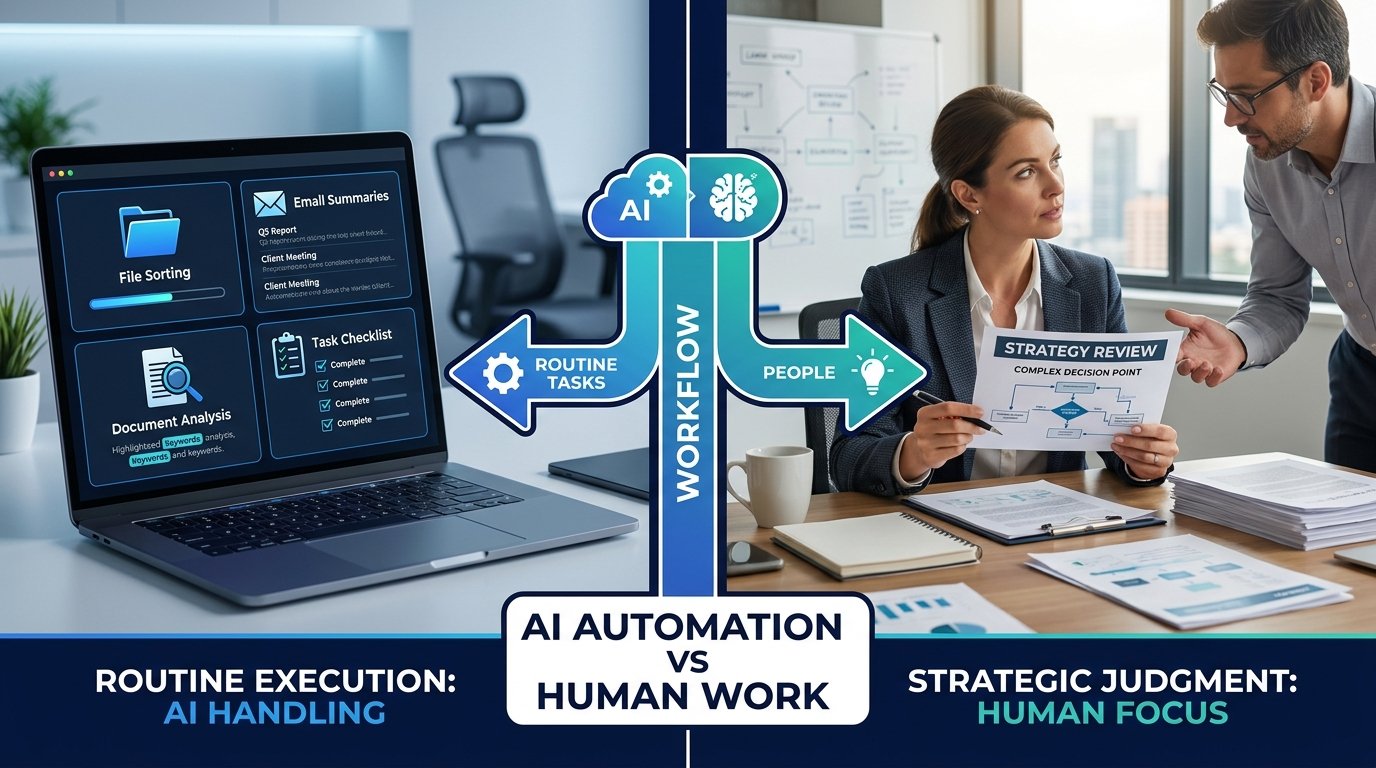
Smart tools save time, but they can’t do everything. This guide helps Pakistani students, freelancers, and business owners choose wisely. You’ll learn what to hand over and what to keep.
AI Automation vs Human Work: What Is the Difference?
AI can finish a task alone, help you with it, or stay out of it. Simple jobs with clear rules suit workflow automation. Risky choices need human oversight. Think of AI as a fast intern who lacks context.
5 Tasks You Can Usually Delegate to AI
These jobs follow clear patterns. Mistakes are easy to spot. They are perfect tasks to automate with AI if you’re just starting.
1. Sorting and Organizing Information
AI sorts files, emails, and spreadsheets in seconds. It also cleans data entry errors and removes duplicates. A shop owner in Faisalabad can tidy a sales sheet in minutes. Spot-check a few rows afterward.
2. Summarizing Documents and Reports
Document summarization turns a 40-page report into one page. It also gives research assistance with ideas and starting points. However, AI can drop small but vital details. Treat every claim as a lead, then confirm it yourself.
3. Drafting Routine Emails and First Content
AI writes polite replies, reminders, and rough outlines quickly. This helps with content drafting and repetitive tasks. A freelancer in Multan can answer clients faster. Always edit before sending, and add your own voice.
4. Transcribing Meetings and Extracting Action Items
AI turns meeting audio into text and lists who must do what. This improves workflow efficiency for busy teams. Names may get misheard, though. Read the notes quickly and fix errors before you share them.
5. Categorizing Customer Questions and Scheduling Routine Workflows
AI sorts billing, delivery, and complaint messages. It also sends reminders for fee deadlines and invoices. Good routine administrative work runs smoothly this way. Angry or urgent messages still need a human. Test the setup for one week.
4 Tasks Where Human Judgment Should Lead
Some jobs carry real consequences. Here, human judgment vs AI is not a close contest. These are tasks humans should not delegate to AI. AI may support you, but a person decides.
Making High-Stakes Financial and Legal Decisions
Large payments, contracts, and tax filings need a careful person. AI can flag odd items during risk assessment. But you carry the accountability. Share only needed sensitive information with any tool.
Handling Sensitive Conversations and Unusual Customer Problems
Layoffs, grief, and strange complaints need empathy. A cold automated reply hurts trust. AI may help you find words. Still, people remember how you made them feel. A damaged parcel with no receipt needs thought.
Making Final Hiring Decisions
AI can screen resumes quickly. However, it may copy past bias. A hiring manager should interview candidates and decide. Skills, attitude, and growth don’t always show on paper. Fair choices need human expertise.
Setting Strategy and Verifying High-Impact Information
AI can study market data. But you understand local culture, timing, and budgets. Pakistani markets change fast. Also, do your own fact-checking on news, health, and legal claims. Good quality control protects your name.
Tasks Where Humans and AI Should Work Together
Many jobs sit in the middle. Human and AI collaboration works best here. Writers, marketers, coders, and planners all gain. AI speeds up the first step. You guide, correct, and finish.
Take a blog post. AI suggests an outline and a draft. You add real stories and fix facts. In coding, AI proposes a function while you test it. This mix is AI-assisted decision-making. Speed meets care.
A Simple Framework for Deciding What to Delegate
Ask four questions. Is the task repeatable? Is the risk low? Can you spot errors fast? Does it need personal context? These answers show how to decide what to delegate to AI. Use this table as a quick guide.

Context changes the answer. Higher stakes need more checks. The NIST AI Risk Management Framework offers useful risk principles. Pakistan’s Ministry of IT and Telecom shares national AI policy updates. Weighing AI automation vs human work this way keeps your choices clear.
Common AI Delegation Mistakes to Avoid
The biggest error is blind trust. AI can sound confident and still be wrong. Another mistake is automating a whole job at once. Start small. Add error detection steps before you grow.
Also, count the review time. Sometimes checking takes as long as doing the work. Smart AI automation at work needs regular audits, especially with autonomous AI agents. Keep records of what the tool handles.
Frequently Asked Questions
What tasks should you automate first?
Start with low-risk repetitive tasks. Sorting emails, tidying spreadsheets, and drafting simple replies are good picks. They show fast results. Then expand step by step.
Which tasks should never be fully delegated to AI?
It shouldn’t decide alone. Legal, medical, hiring, and large financial choices need people. AI may advise. A person approves and owns the result.
Does AI automation always save time?
No. Weak setup or heavy review can cancel the gains.
What are the risks of AI automation?
They include errors, bias, and data leaks. Test first and track real time saved.
When should a human review AI output?
Review it whenever mistakes could cost money, trust, or safety. Low-risk tasks need light checks. High-risk tasks need full review every time.
Conclusion
Smart delegation is a skill. Let AI handle patterns and speed. Keep people in charge of care, ethics, and final calls. Pick one small task today and test it. Done well, AI automation vs human work becomes a partnership instead of a contest.