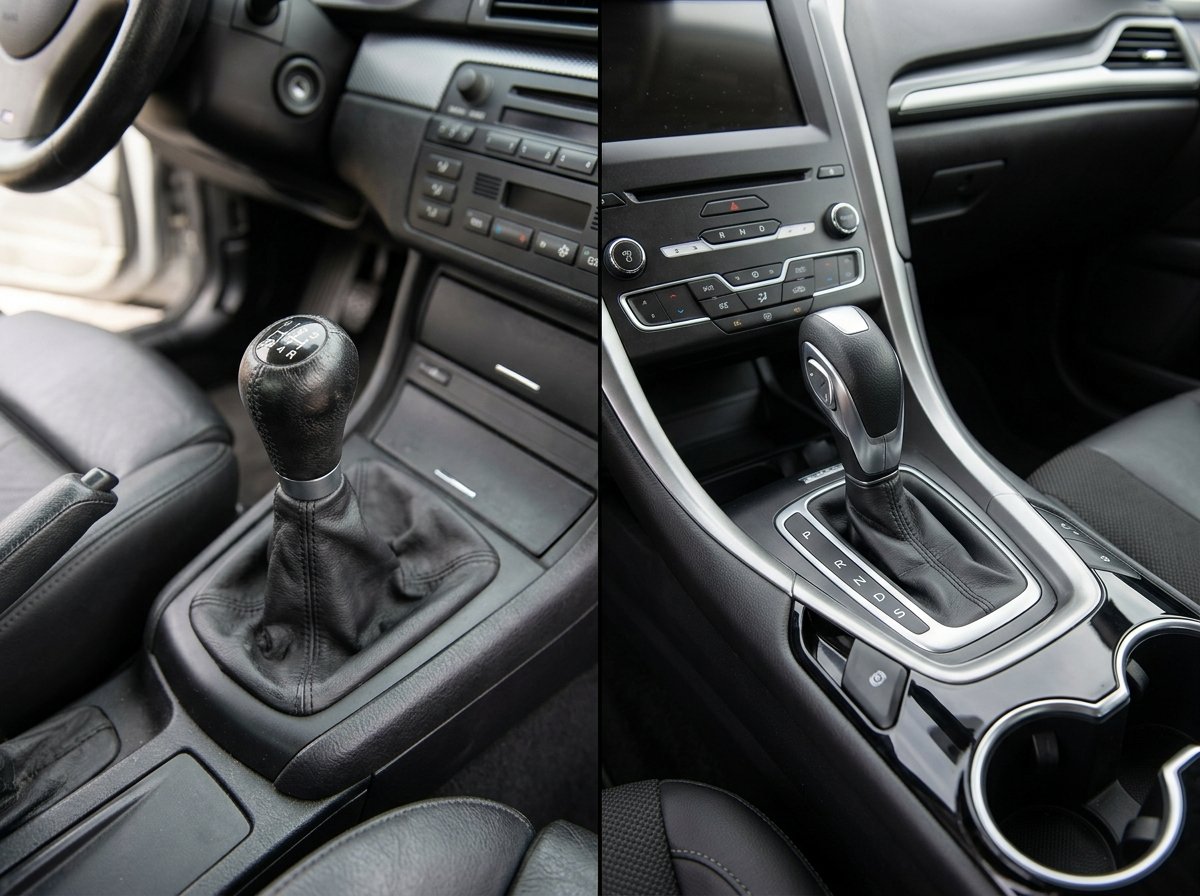
Here's a fact that a lot of drivers aren't aware of: new automatic transmissions sometimes get more efficient use of fuel than the manual transmission. That one fact stops an argument that's been going on for over 60 years.
We've all been there, riding along in a vehicle while someone else fights with the stick on a 'stick versus auto' debate. Where do you sit? 'Tis' a control and experience guy…or I hate the idea of shifting in traffic guy. Speaking to reality, they are both right.
How Each Transmission Actually Works

A manual gets its name from the clutch pedal and gear stick. It is the driver that decides when a gear change occurs. The driver, rather than the vehicle, controls the flow of power, which is what makes them so popular.
An auto shift uses a torque converter (or in newer vehicles, a dual clutch or CVT system) and shifts gears automatically. You just step on the pedal and brake.
Dual-clutch transmissions (DCTs) are even more confusing. They shift like an automatic but have two internal clutches, so they change gears almost instantly, akin to a talented manual car driver.
The Driving Experience Gap

Driving (for me) can be relaxing, because I have to pay attention to the road, the engine speeds, the masses of cars rushing past behind the glass. For some people this is tiresome. For others this is what makes driving interesting.
The automatics have the major advantage of hands free motoring, so you can concentrate on other issues: your coffee, the bangin' new podcast you'd just found, your teenage mama moaning in the back. In the stop-start rush of city traffic, that really counts.
Here's a little known fact. On the whole, many of the auto insurers in the UK and elsewhere in Europe (which automatics in some countries are significantly cheaper) tend to be a little cheeper for the theft premiums for stick based cars, because not as many person thieve know how to drive a stick. Its not a lot, but it is there... And very few people ever bring it up.
Fuel Efficiency and Performance Numbers

Decades ago, manual transmissions dominated the fuel economy standings. Not entirely true today. Today's automatics-both CVT and 8- to 10-speed transmissions-regularly outperform a manual in the real-world MPG department because they shift at the perfect RPM every time.
A dedicated manual shifter can still best out a computer sometimes-such as deciding when to most aggressively downshift on a mountain switchback. But for typical driving conditions, the automatic generally beats it on paper now.
Performance cars, though-they're in a league of their own. Most super cars abandoned manual transmissions altogether because dual clutch automatics shift at velocities that no human can match.
Maintenance Costs and Longevity

Implementing a manual transmission is mechanically less complex than an automatic one, so repairs are usually less expensive if any problem occurs. The main cost is replacing the clutch, which is quite a reliable task.
They are also complex, and have many more parts that can go wrong: solenoids, torque converters, valve bodies. When something does go wrong, it seems the repair bill on automatics is, on average, higher, though the modern units are much more reliable than those of 20 years ago.
CVTs have a specific reputation for expensive repairs if never, since they employ a belt and pulley system rather than conventional gears. More than many car owners understand, frequent fluid changes are critical.
Which One Should You Actually Buy

If you're in heavy traffic most of the time, want lower long-term stress, and couldn't give a damn about shifting; an automatic is the best option for daily life. That's most people.
If you genuinely do enjoy the tactile connection to the car, whatever reason you have for it, a daily-drivingspecifics/roll.
Resale value will matter as well, depending on your market. Automatics, even in the US, are in market demand for resale. Some regions of Europe, Asia, and Latin America have 1990's era,"mean well"automatics selling faster than manuals as well.
There isn't a set winner when it comes to manual vs automatic transmissiononly the one that suits how and where you actually drive. If possible take both for a spin and let the daily grind decide.
Frequently Asked Questions
1. Is manual transmission harder to learn than automatic?
It does take some practice. You have to learn to operate the clutch/speed shifts, which doesn't happen overnight. But it only takes a few weeks of practicing it regularly before it becomes second nature. For many people, stalling on hills can be frustrating initially.
2. Do automatic cars really get better gas mileage now?
In a lot of newer cars, yes - automatic transmissions with more gears or CVT systems tend to shift more quickly and smoothly than you. Well, they didn't used to a decade ago, so older comparisons are irrelevant.
3. Which transmission lasts longer, manual or automatic?
The manuals are mechanically more straightforward (and somewhat cheaper to repair) but a well-maintained automatic transmission can be just as durable. So you are more to do with the owner care as length of life.
4. Are manual cars cheaper to insure?
Where there's them sometimes, it's driven by the risk of theft rather than driving one, as drives a stick becomes less and less as people learn to drive manual. Though it really depends on the country and the insurer.
5. Why are manual transmissions disappearing from new cars?
Car manufacturers are moving toward manuals and DCTs because they're simpler to build in large quantities and they're more compliant with emissions standards, plus they attract a broader customer base. Normal sedans are becoming more and more automatically; manuals are remaining more and more enthusiast- and sports-oriented.