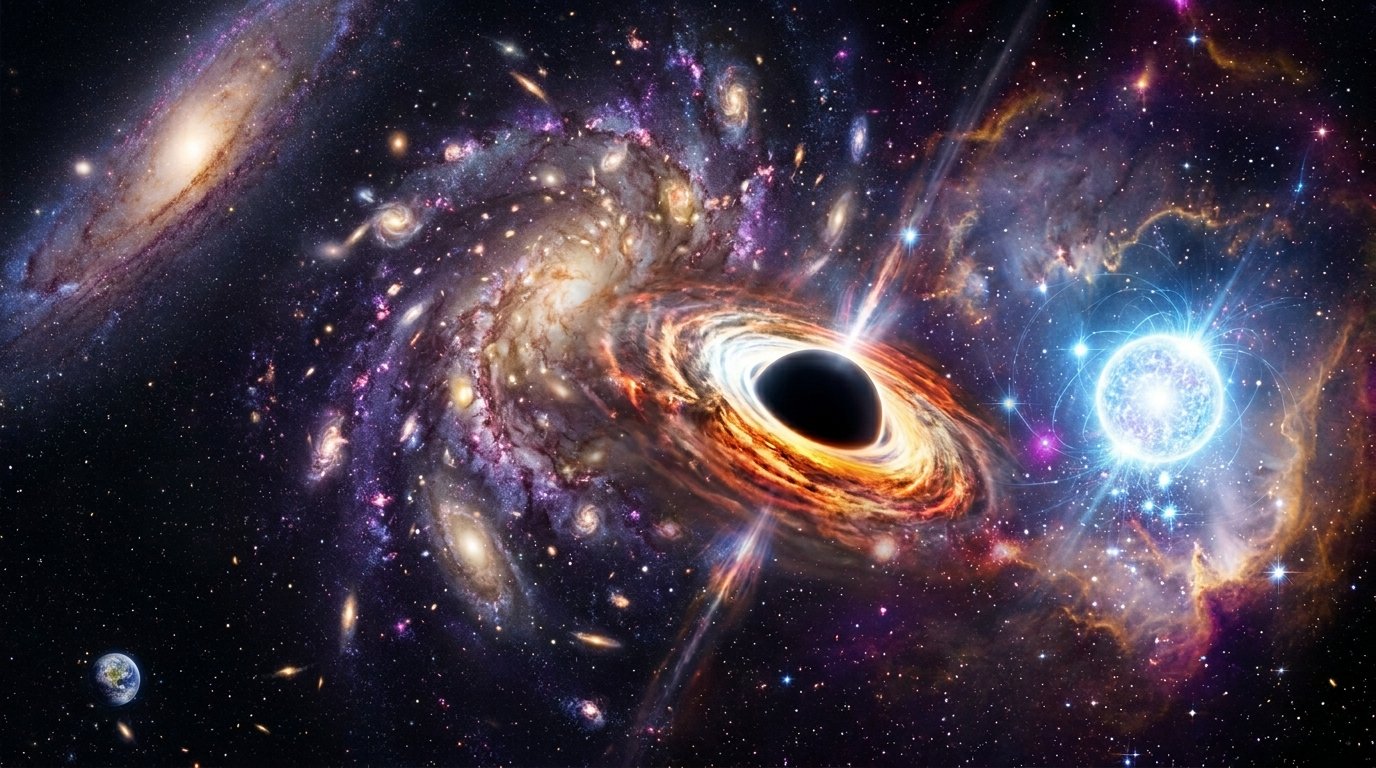
The universe is so large that if you tried to count every star in it at one per second, it would take roughly three trillion years to finish.
That single number dismantles every assumption most people carry about the scale of existence. Space is not just big. It is incomprehensibly, violently, beautifully enormous, and almost everything happening inside it defies common sense. Here are 12 facts that prove it.
Space Is Completely Silent, Yet Not Entirely Quiet
Sound waves require matter to travel. In the vacuum of space, there is virtually none. You could stand next to an exploding star and hear absolutely nothing.
But space is not fully silent. Electromagnetic vibrations, plasma waves, and magnetic field interactions exist everywhere. NASA has translated these invisible signals into actual audio, producing haunting soundscapes from black holes and nebulae that scientists genuinely study.
One Teaspoon of a Neutron Star Weighs Over a Trillion Kilograms
Neutron stars form when massive stars collapse under their own gravity. What remains is an object roughly the size of a city, packed with more mass than the Sun.
A single teaspoon of neutron star material weighs more than the entire human population combined. To match that density, every human being on Earth would need to be compressed into the size of a sugar cube.
We Can Only See 5% of the Universe
Dark energy makes up 68% of the universe. Dark matter accounts for another 27%. Neither can be seen, touched, or directly detected with any telescope currently in existence.
Everything humans have ever observed, every star, planet, galaxy, and nebula, represents just 5% of what actually exists. The rest remains invisible and deeply misunderstood.
A Day on Venus Is Longer Than Its Year
Venus rotates so slowly on its axis that a single day there lasts 243 Earth days. Yet it completes a full orbit around the Sun in just 225 Earth days.
On Venus, a day is literally longer than a year. It also rotates in the opposite direction to most planets, meaning the Sun rises in the west and sets in the east.
The Milky Way Smells Like Rum and Raspberries
At the center of the Milky Way sits a gas cloud called Sagittarius B2. Scientists using a radio telescope detected ethyl formate within it, the same chemical compound responsible for the taste of raspberries and the smell of rum.
The core of our own galaxy carries the aroma of a cocktail bar. It is one of the strangest confirmed facts in modern astronomy.
Mars May Already Hold Evidence of Ancient Life
The Chevaya Falls Discovery
In July 2024, NASA's Perseverance rover found a rock in Mars's Jezero Crater covered in unusual spotting resembling poppy seeds and leopard print. Named Chevaya Falls, the rock contains organic carbon, sulfur, phosphorus, and minerals associated with microbial metabolism on Earth.
Scientists now consider it the clearest potential biosignature ever found on another planet. A sample has been stored for future return to Earth.
The Sun's Light Takes Eight Minutes to Reach Earth but 100,000 Years to Leave the Sun
Photons generated in the Sun's core take between 10,000 and 170,000 years to travel from the core to the surface due to the extreme density of solar material. Once they escape, they cross 93 million miles to Earth in just eight minutes.
The sunlight warming your skin today began its journey inside the Sun before modern humans existed.
The Universe's Expansion May Be Slowing Down
For decades, scientists believed the universe was expanding at an accelerating rate. New data from the Dark Energy Spectroscopic Instrument, analyzing nearly 15 million galaxies, suggests that acceleration may be weakening.
If confirmed, this could point toward an eventual "Big Crunch," in which the entire cosmos ultimately collapses back on itself. It would rewrite the Standard Model of particle physics entirely.
A Gamma-Ray Burst Outshines an Entire Galaxy
The Most Powerful Events in the Known Universe
Gamma-ray bursts are brief flashes of high-energy radiation that, for a fraction of a second, release more energy than the Sun will produce across its entire 10-billion-year lifespan.
They outshine entire galaxies in that single moment. Some occur when massive stars collapse. Others happen when two neutron stars collide. Both scenarios are cataclysmic beyond any human frame of reference.
Total Solar Eclipses Are a Coincidence That Will Not Last Forever
The Sun is 400 times larger than the Moon. It is also 400 times farther away. This precise cosmic coincidence makes both objects appear exactly the same size from Earth, allowing the Moon to perfectly cover the Sun during a total solar eclipse.
The Moon is slowly drifting away from Earth at about 3.8 centimeters per year. Eventually it will appear too small to cover the Sun, and total solar eclipses will become impossible forever.
Three Exoplanets Were Discovered Around the Second Closest Star to Earth
In early 2025, astronomers confirmed three exoplanets orbiting Barnard's Star, located just 6 light-years from Earth. It is the closest single star to the Sun.
This makes Barnard's Star one of the nearest known planetary systems in the entire galaxy, and a significant target for future habitability research.
A Supermassive Black Hole May Be Eating a Neighboring Galaxy
The Large Magellanic Cloud, one of the Milky Way's closest galactic neighbors, appears to harbor a supermassive black hole at its center. ESA's Gaia mission observed 21 stars being flung out of the galaxy after apparently encountering this black hole.
Entire stars are being ejected from a nearby galaxy right now, moving at speeds that will send them into permanent intergalactic exile.
The Universe Keeps Getting Stranger the Closer We Look
Every instrument humans build, every telescope launched, and every mission sent into the void returns with information that raises more questions than it answers. Space is not a backdrop. It is an active, violent, astonishing system in constant motion.
The more honestly you look at it, the more clearly you understand that the universe has no obligation to make sense on a human scale. It simply is, in all its staggering, indifferent, magnificent complexity.
Frequently Asked Questions
How old is the observable universe?
The universe is approximately 13.8 billion years old, a figure calculated using the cosmic microwave background radiation and the known rate of expansion.
What is dark energy?
Dark energy is the term scientists use for the unknown force driving the accelerating expansion of the universe. It accounts for roughly 68% of all energy in existence but cannot be directly observed or measured.
Is there sound in space?
Not in the way humans experience it. Sound waves cannot travel through the vacuum of space. However, electromagnetic vibrations exist and can be converted into audible signals, as NASA has demonstrated with recordings from black holes and nebulae.
Could there be life on Mars?
No confirmed life has been found, but the 2024 discovery of Chevaya Falls, a rock containing organic carbon and minerals associated with microbial activity on Earth, represents the strongest evidence yet that ancient microbial life may have existed on Mars.
Why do total solar eclipses happen only on Earth?
Total solar eclipses require a precise size and distance relationship between a moon and its star. On Earth, the Sun and Moon appear the same size due to a remarkable coincidence in their actual size and distance ratios, making perfect solar eclipses a feature unique to our planet in the known solar system.