Most Muslims perform Salah five times a day, yet studies of Islamic scholarship consistently show that a significant number of worshippers unknowingly repeat the same avoidable mistakes in every single prayer.
That is not a small problem. The Prophet Muhammad, peace be upon him, said: "The first matter that the servant will be brought to account for on the Day of Judgment is the prayer. If it is sound, then the rest of his deeds will be sound. And if it is corrupted, then the rest of his deeds will be corrupted." (At-Tirmidhi)
If prayer is the foundation of your deeds, you cannot afford to build it on errors. Here are the most common prayer mistakes and exactly how to fix them.
Mistake 1: Praying Without a Clear Intention
One of the biggest mistakes is praying without focusing on the prayer itself, without consciously making the intention in the heart before beginning. Noor Ul Islam
Niyyah is not a verbal statement. It is a deliberate mental affirmation made in the heart before you begin. Many people simply stand up out of habit and begin without any conscious awareness of what they are about to do or for whom they are doing it.
Fix it: Before every Salah, take a brief moment. Be fully aware that you are standing before Allah. Make the intention clear in your heart, state which prayer you are about to perform, and then begin.
Mistake 2: Rushing Through Ruku and Sujood
Abdullah ibn Mughafal reported the Prophet, peace be upon him, said: "Verily, the worst thieves among people are those who steal from their prayers." They were asked how they steal from prayers and the Prophet said: "They do not complete its bowing or prostration." Muslimvoiceforpeace
This is among the most widespread and serious prayer mistakes committed daily. Rushing through Ruku and Sujood is not just poor form. According to scholars, it can render the Rakah invalid.
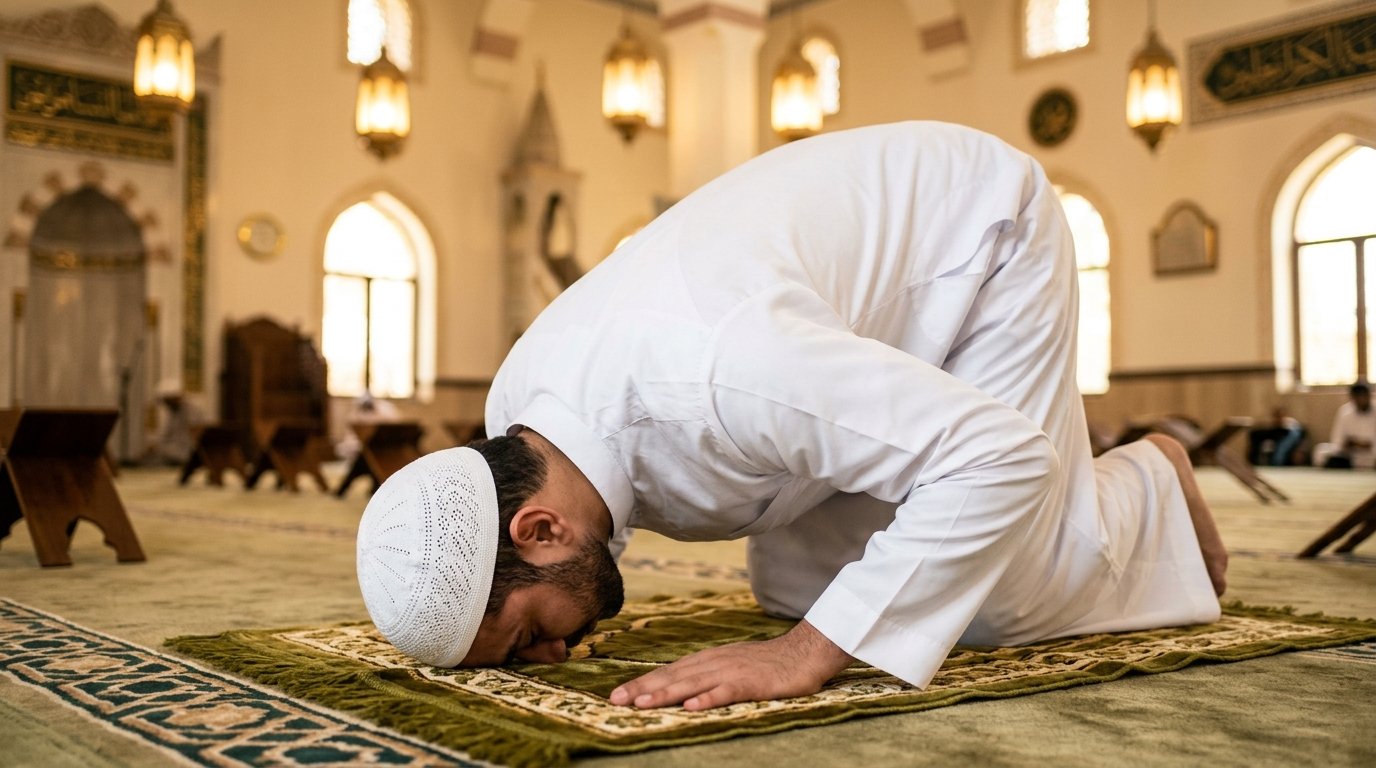
During Sujood, the forehead, nose, both palms, both knees, and all toes must be touching the ground. During Ruku, the back must be straight and parallel to the ground with hands resting firmly on the knees. Noor Ul Islam
Fix it: Pause in each position. Recite the Tasbeeh slowly and with meaning. Do not move to the next position until your body and heart have settled.
Mistake 3: Allowing the Mind to Wander Completely
Our bodies may be standing in prayer, but our minds are chasing errands, emails, or dinner plans. While distractions are human, Khushu is the essence of Salah. My Salah Mat
The scholars of Islam are unanimous that a prayer performed without any inner presence is a deeply deficient prayer, even if it technically fulfils the outward obligation.
The antidote to a wandering mind is not willpower alone. It is understanding what you are saying. When you know the meaning of every word of Surah Al-Fatiha, every Tasbeeh in Ruku, and every phrase in Tashahhud, your mind has something to hold onto.
Fix it: Learn the meanings of the words you recite. Visualise that you are standing directly before Allah. Begin with shorter Surahs recited slowly and with reflection rather than longer ones recited mindlessly.
Mistake 4: Incorrect or Incomplete Wudu
Incomplete or incorrect Wudu can invalidate the prayer entirely. Ensuring that every step of the ablution is performed properly before beginning Salah is not optional. It is a condition without which the prayer is not accepted. Noor Ul Islam
Many people wash their faces, arms, and feet quickly without ensuring complete coverage of every part. Some are unaware that wiping the head and washing the ears are obligatory components of Wudu.
An invalid Wudu means an invalid prayer, regardless of how beautifully the rest of the Salah is performed.
Fix it: Learn the obligatory steps of Wudu from a reliable Islamic source and perform them with full presence and thoroughness every single time.
Mistake 5: Incorrect Recitation of Surah Al-Fatiha
If the mistake occurs in Al-Fatihah, then it must be corrected, because Al-Fatihah is a pillar and essential part of the prayer without which the prayer is not valid. Islam Question & Answer
Mispronouncing letters in Al-Fatiha can change the meaning of the words fundamentally. This is not a minor stylistic concern. Tajweed, the proper pronunciation of Quranic Arabic, is directly tied to the accuracy and validity of what is being recited before Allah.
Skipping letters, merging words incorrectly, or mispronouncing certain Arabic sounds can alter the meaning of what you are saying to Allah.
Fix it: Study Tajweed systematically. Begin with Al-Fatiha specifically. Recite it slowly before a qualified teacher or use trusted audio resources until your pronunciation is accurate.
Mistake 6: Excessive and Unnecessary Movement
It is widely agreed among scholars that engaging in excessive and continuous movement can nullify the prayer. Whether such movements are disliked or prohibited, they undoubtedly serve as distractions during prayer and can diminish Khushu. Muslimvoiceforpeace
Fidgeting with clothing, adjusting the prayer cap, checking the phone, looking to the left or right, these are not trivial habits. They are acts that disconnect the worshipper from the spiritual reality of what Salah is meant to be.
Every unnecessary movement in Salah is a signal to your own heart that something else is more important than the conversation you are having with Allah.
Fix it: Before beginning, ensure your clothing is properly arranged, your phone is completely silenced, and your prayer space is free from distractions. Minimise all movement from the first Takbir to the final Tasleem.
What to Do When You Realise You Have Made a Mistake Mid-Prayer
Prevention is the best approach. Being mindful when making Wudu, mindful when starting the prayer, and mindful while praying is the strongest defence against mistakes in Salah. About Islam
However, when a mistake does occur, Islam has provided a clear and merciful solution. If a praying person forgets to perform a pillar of the prayer and remembers it before reaching the same act in the following Rakah, he must perform that act and then complete all the acts that follow it. IslamWeb
For omitted obligatory acts or extra Rakahs performed out of forgetfulness, the prescribed remedy is Sujood as-Sahw, two prostrations of forgetfulness performed after the Tasleem. Sujood as-Sahw is a divine mercy, a provision that acknowledges human forgetfulness and provides a structured correction.
Fix it: Learn the rules of Sujood as-Sahw from a reliable source. If you realise you have made a mistake during prayer, correct it immediately. Ignoring known mistakes can invalidate the prayer. Noor Ul Islam
Conclusion
Salah is the most important act of worship in a Muslim's daily life. It deserves your full attention, your correct posture, your accurate recitation, and your complete heart. The mistakes covered here are not meant to create anxiety. They are meant to create awareness.
Correcting these errors is not about guilt. It is about respect for the gift of prayer itself. The Prophet, peace be upon him, said: "Pray as you have seen me pray." That command is both a responsibility and an invitation to do better every single day.