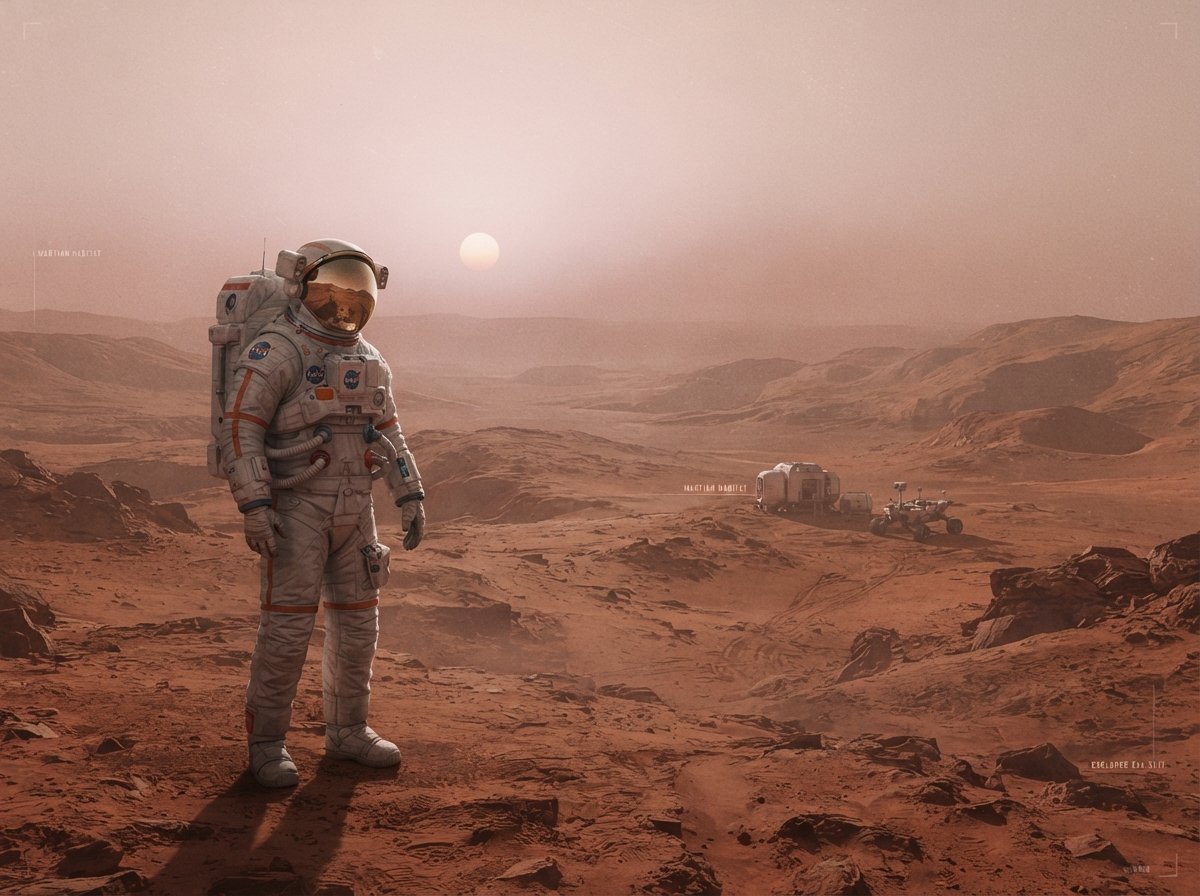
If you tried to step outside without any protection on Mars, you would lose consciousness within about fifteen seconds. That is how thin the Martian atmosphere is, less than one percent of Earth's pressure, and it is the first thing anyone imagining human life on Mars needs to understand. Living on Mars would not just be uncomfortable, it would be genuinely tough. It would require rebuilding almost every assumption we have about survival.
Gravity Would Reshape the Human Body
Mars has about 38 percent of Earth's gravity. That sounds like it might make life easier, and in some ways, moving around would feel lighter and less strenuous. But the human body evolved under Earth's gravitational pull, and reduced gravity on Mars causes real problems over time.
Bone density drops, and muscles, including the heart, weaken from reduced resistance. Astronauts on the International Space Station, even after just a few months in microgravity, return to Earth needing physical rehabilitation. Mars gravity is stronger than zero gravity, so the effects there would likely be less severe than in orbit, but nobody has lived under partial gravity long enough to know the long-term outcome. Children born on Mars, if that ever happened, might develop skeletons and cardiovascular systems different from people raised on Earth.
Radiation Exposure Without a Magnetic Shield
Mars does not have a magnetic field to deflect most harmful solar and cosmic radiation before it reaches the surface. Earth's magnetic field protects us, but Mars lost its global magnetic field billions of years ago, so its surface receives significantly more radiation than Earth's.
This is not an occasional hazard, it is constant. Anyone living on Mars long term would face elevated cancer risk unless properly shielded, which is why realistic habitat designs bury living quarters under several feet of Martian soil or use thick water-based walls to absorb radiation. Surface living without heavy shielding simply is not survivable over years, not just days. This single requirement shapes nearly every other decision about how a Mars colony would be built.
Breathing Would Depend Entirely on Machines
The atmosphere on Mars is roughly 95 percent carbon dioxide, with barely any oxygen. There is no point on the planet where a person could step outside and breathe naturally, not even atop Mars's tallest mountain. Every breath a Mars resident takes would come from equipment.
This changes daily life in ways people underestimate. It is not just about wearing a suit outdoors. Indoor spaces would need continuous life support systems monitoring oxygen levels, filtering carbon dioxide, and maintaining pressure. A mechanical failure would not be a minor inconvenience, it would be an emergency with a countdown attached.
Temperature Swings Are More Extreme Than Most People Realize
Mars can reach a relatively mild 70 degrees Fahrenheit at the equator during the day, but temperatures can plunge to negative 100 degrees Fahrenheit or lower at night. This happens because the thin atmosphere holds almost no heat.
Buildings on Mars would need serious insulation, and any outdoor work would have to be scheduled around these swings. Unlike Earth's weather, where seasonal change is gradual, a Martian day can feel like moving between a cool afternoon and an arctic night within hours.
Growing Food Would Require Rethinking Agriculture Entirely
Mars soil, called regolith, contains perchlorates, chemical compounds toxic to humans in high concentrations. Farming directly in Martian soil is not an option without first processing it to remove these compounds.
Realistic food production on Mars would likely rely on hydroponic or aeroponic systems inside controlled environments, where nutrients, water, and light are all engineered rather than naturally occurring. Sunlight on Mars is about 60 percent as intense as on Earth, so supplemental lighting would probably still be necessary even for surface greenhouses. This is one of the areas where Mars living connects directly to the same technology already used in vertical farming on Earth, just adapted for a much harsher setting.
Mental Health in Isolation
Physical survival gets most of the attention, but psychological strain is a serious concern too. A Mars colony would be isolated, with communication delays to Earth ranging from about four to twenty-four minutes each way depending on planetary positions. Real-time conversations would not exist.
Confined living spaces, limited privacy, and distance from everything familiar would test even well-prepared crews. Studies from long-duration Antarctic research stations, often used as an analog for space isolation, show that morale and cohesion become as important to mission success as the engineering itself.
Living on Mars would not resemble a longer camping trip or a distant version of Earth life. It would mean depending on machines for air, shielding for radiation, and careful planning for food and water at every stage. The physical challenges are significant, but so are the human ones, and any serious plan for humans living on Mars has to treat both as equally critical to survival.
Frequently Asked Questions
Could humans survive on Mars without any technology?
No. Mars's atmosphere, radiation levels, and temperature extremes make unprotected survival impossible within minutes. Any human presence would depend entirely on engineered life support systems.
How long would it take to travel to Mars?
A one-way trip currently takes six to nine months, depending on the alignment of Earth and Mars during launch. This timing also affects when return trips or resupply missions can realistically happen.
Would plants grow on Mars naturally?
Not without help. Martian soil contains perchlorates and lacks the organic matter needed for plant growth, so any farming would require treated soil or soilless growing systems indoors.
Is Mars's gravity strong enough to prevent health problems?
It reduces some effects seen in zero gravity, but 38 percent of Earth's gravity is still not enough to fully protect bone density and muscle mass over long periods, based on what's known from space research.
Could future generations be born and raised entirely on Mars?
It's technically conceivable, but no research currently confirms how partial gravity and elevated radiation would affect human development from birth. This remains one of the biggest unknowns in Mars colonization plans.