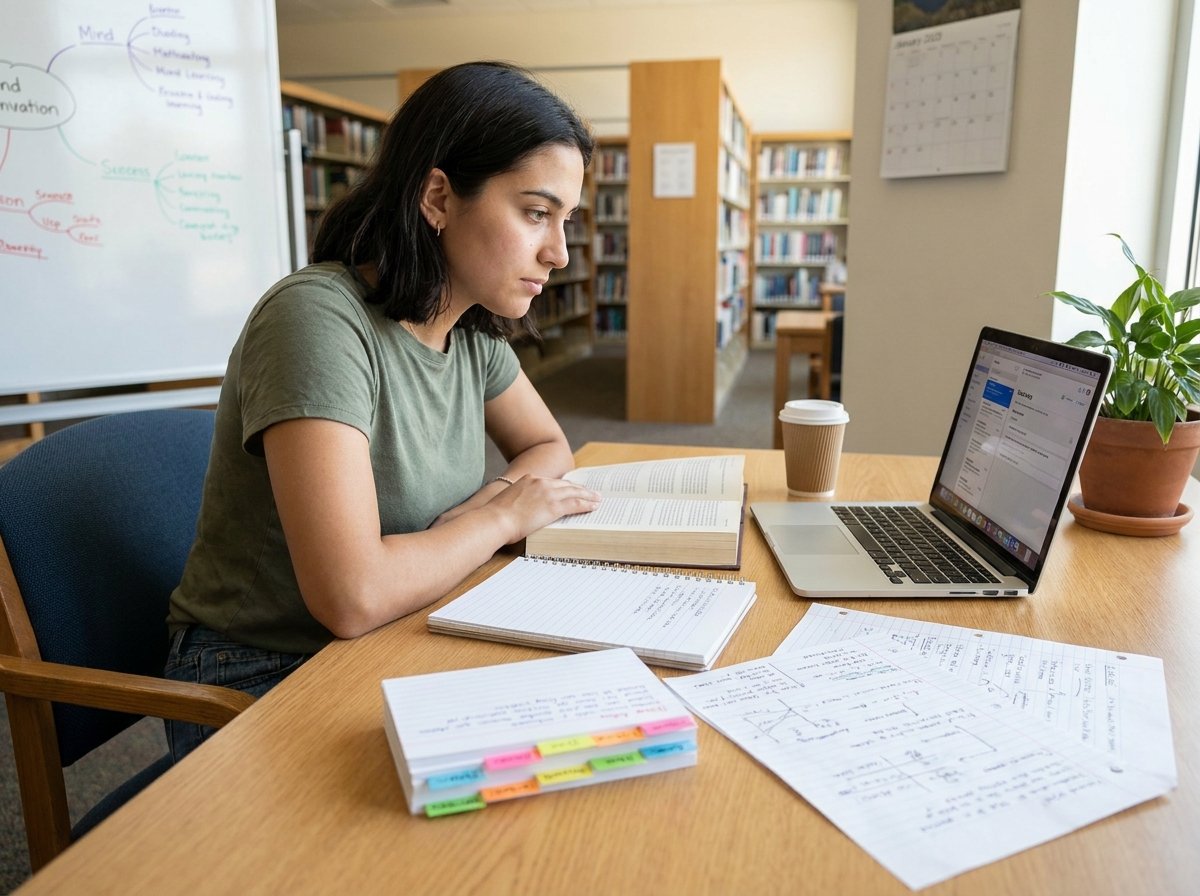
Studying for a long time does not always mean you are learning properly. Some methods make the information seem familiar while you are looking at your notes, but they do not help you remember it later. Studies about learning and memory show that good study methods help you remember more, including recalling information, spacing out study times, mixing up topics, explaining ideas, and talking through what you know.
The main difference is simple: good studying makes your brain work with the information instead of just seeing it over and over. Here are study methods that have been proven to work.
1. Try To Remember Without Looking
Recalling information means trying to remember it without looking at the answer. Close your book. Explain the topic, answer questions, or write down everything you remember on a blank page.
Studies have shown that trying to remember information can help you keep it longer. Practice tests and recalling things from memory are some of the ways that help with remembering.
The important thing is to test yourself before looking at your notes, not after.
2. Spread Out Your Study Times
Instead of studying one chapter for three hours the night before a test, split that time into several sessions. Study the material today, come back to it later, and test yourself again after some time.
This is called spaced study. Studies show that spacing helps you remember better than studying all the material in one go.
For example, you could study a computer topic on Monday, review it on Wednesday, and recall it again on Saturday.
3. Mix Topics Or Problems
Mixing different topics or types of problems instead of doing all of one type first is called interleaving.
Imagine you are studying math. Instead of doing ten similar equations in a row, mix different kinds of problems and decide which method to use for each. This makes you recognize the problem and choose the method.
Studies say that mixing up topics can help you do better later, especially when you have to tell the difference between ideas or problems.
4. Explain Ideas In Your Own Words
After reading something, put the book away and explain it as if you were talking to a friend. Do not just repeat the textbook's words. Explain what the idea means, why it is important, and how it connects with things you already know.
This way of learning is called elaboration and self-explanation. Studies say elaboration helps because it connects new information with what you already know.
If you can't explain a topic without your notes, that means you need to learn more about it.
5. Ask How And Why Questions
Turn statements into questions. Instead of remembering "a process moves through different states," ask yourself "Why does a process change state?" or "What would happen if this state changed?"
This method, called questioning, helps you see the links between facts instead of just memorizing them. It can be very helpful when you already have some knowledge to build good explanations.
6. Use Words With Pictures
Combining words and pictures is called dual coding. For example, when studying a computer network, you might read about it while also drawing a picture showing how the parts communicate.
The picture should actually show the idea. Adding decorations is not the same as making a helpful image. Studies say dual coding is one of the strategies that helps learning.
7. Learn With Examples
It can be hard to understand ideas without examples. When learning a concept, look for or create a real situation that shows how it works.
For example, after learning about a database transaction, work through an example involving a customer payment. Examples help you connect ideas with real situations.
8. Practice With Questions Before The Test
Questions are more helpful when you have to find the answer instead of just recognizing it.
After studying a chapter, put your notes away. Answer questions from memory. When you make a mistake, check the answer, understand why you were wrong, and try the question again later.
A practice test should be seen as a way to learn, not a guess of your test score.
Studies on testing show that practice tests and other ways of recalling information help with remembering.
9. Use A Blank Page To Remember
Take a paper and write down everything you remember about a topic without looking at your notes. Include definitions, processes, examples, formulas, and connections between ideas.
Then check your paper against your study material. Mark what you missed and focus on those parts in your next study session.
This method uses recalling and feedback to show what you actually know, not what looks familiar.
10. Teach The Topic To Someone Else
Imagine you are teaching the subject to another person. Explain the idea from the beginning, use an example, and answer questions.
Teaching is not always better than other study methods, but the process of explaining can help you recall, explain, and find gaps in your knowledge. If you get stuck, go back and read that part of the chapter again.
11. Use More Than One Method
The best way is often to use several methods together. You might first learn a topic, make a drawing, explain the idea in your own words, test yourself without notes, and then come back to the material a few days later.
Studies say combining methods like spacing and recalling can be very helpful.
For example, a student preparing for a test on operating systems could study process states on Monday, draw the process state diagram, close the notes and try to recreate it from memory, explain each state aloud, and test the material again on Thursday.
Which Study Method Should You Try First?
You don't have to change your study habits all at once. Start with two changes: replace some reading with recalling, and spread your study times over several days.
These methods can feel harder than reading the same page again. That feeling does not mean they are worse. Studies say that methods like recalling, spacing, and mixing topics can help you learn better.
The goal is not just to study. It is to use the time you already spend more effectively. When you regularly recall information, space out your reviews, explain ideas, and practice using what you know, your study time becomes more active and focused. Using these study methods can make a big difference in how well you remember and use what you learn.
Frequently Asked Questions
What is the best study method?
Recalling and spacing have research support for helping you remember better. Combining them is a good place to start.
Is reading a way to study?
Reading can help you know the material. Studies say it is not as good as active methods like recalling and spacing. Reading can be part of studying, but not the main way.
How often should I look at my notes?
There is no schedule that works for everyone. The main idea is to study over time and come back to the material after some time has passed, instead of studying everything in one go.
Are flashcards a study tool?
Flashcards can help if they make you really remember the answer, not just see it again. A good flashcard makes you recall the answer before you see it, and reviewing them over time can help with recalling and spacing.