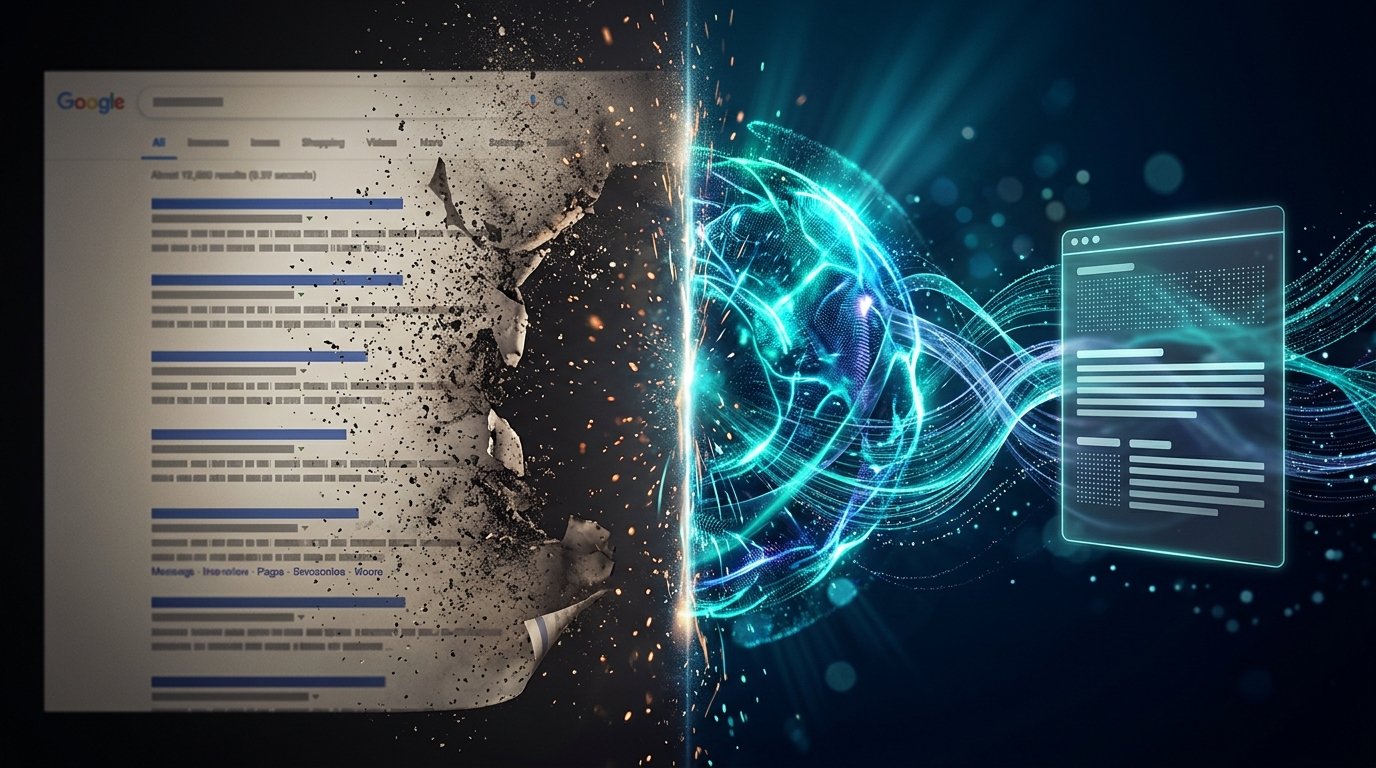
Search is changing fast. AI tools now give you direct answers, while Google still gives you a list of links. This guide explains the difference and helps you decide when to use each one.
AI adoption in Pakistan is still early. A Gallup survey found that only 15% of Pakistanis have used AI tools. That means most people are still learning how these tools work.
What Is AI Search?
AI-powered search gives you a direct answer instead of a list of links. You type a question. The tool reads many sources and writes a short reply. Many people call these tools answer engines or search assistants. This style is also known as generative AI search or generative search.
So how does AI search work? It uses a language model to read your conversational queries. Then it pulls facts from web pages and builds a summary. Good tools add citations so you can check the original sources. That step is a form of information retrieval, and it matters a lot for trust.
How Traditional Google Search Works
How does Google Search work? Google crawls the web and stores pages in a huge index. When you type a query, it ranks pages by relevance and quality. You then see search results in a list. You pick a page and read it yourself.
This is the classic model of traditional search engines. It rewards clear keywords and strong pages. Organic search still sends most of the web its visitors. Google also shows maps, news, shopping boxes, and ads. However, the job stays the same. It helps you find the right website.
AI Search vs Google Search: Key Differences
The gap between AI search vs Google Search is easy to see side by side. One gives you a written answer. The other gives you a menu of choices. Here is a quick view of AI search vs traditional search.
FeatureAI SearchTraditional Google SearchMain outputSynthesized answersRanked list of resultsStyleConversationalKeyword or query basedFollow-up questionsHandled naturallyOften start a new searchSourcesSummarizes many at onceYou open pages one by oneBest useExploring a topicFinding a specific website
Google now blends both ideas. AI Overviews can lead into Google AI Mode. That mode feels like a chat. It still shows links to the web. So the difference between AI search and Google Search is shrinking each year.
AI Search Tools You Can Try Today
Several AI search engines are ready to use right now. Each one has a different strength.
- Perplexity: Gives direct answers with citations. Good for research.
- ChatGPT Search: Combines conversation with web search. Good for learning.
- Google AI Mode: Google’s own conversational search. Good for follow-up questions.
- Microsoft Copilot: Uses Bing’s index with AI answers. Good for general queries.
How AI Is Changing the Way People Search
Search behavior is shifting fast. People now write long-form queries like full sentences. They ask for comparisons. They ask for summaries. Then they ask follow-up questions to go deeper. These new search habits turn one search into a small chat. This is how AI is changing search at the user level.
Research backs this up. A 2026 Microsoft Research eye-tracking study found that generative-AI content gets much more attention than classic results. Yet people still click regular links too. So how people search for information is not one path. It is a mix. Users move between answers and links as their search intent changes.
When Should You Use AI Search?
Use AI when you want to understand something. It shines at information discovery. Ask it to explain a hard topic in plain words. Ask it to compare two phones or two study plans. It can also brainstorm ideas and summarize long text. These are the top AI search advantages.
Think of a student who needs a quick overview of cloud computing. An AI tool gives a clear summary in seconds. The student can then ask, “Explain it more simply.” That flow saves time. Still, treat the answer as a starting point. Always check the citations before you trust a fact.
When Is Google Search Still Useful?
Google is still the better tool for many jobs. It is great for finding a specific site or an official page. It works well for local shops, current news, and shopping. It also helps you compare several original sources side by side. These are core Google Search advantages.
AI tools can also make mistakes. They may sound sure while being wrong. That is a real AI search disadvantage. Google has limits too. You must sort through many links yourself, and ads can crowd the page. These are common Google Search disadvantages. Smart users know both sets of limits.
Is AI Search Replacing Google Search?
The honest answer is not a simple yes or no. The two are now overlapping. Google reports that AI Overviews has more than 2 billion monthly active users, according to the company’s official blog. It also says AI Mode has passed 1 billion monthly users, according to multiple reports from 2026. So Google is adding AI to its own product instead of losing ground to it.
Outside data shows the same mix. YouGov research suggests people use classic search alongside AI assistants. So can AI search replace Google? Not fully, at least for now. Will AI replace search engines? More likely, search engines will absorb AI. This is the clearest view of AI search vs Google Search today.
How AI Search Could Change SEO
SEO is changing, but it is not dead. Search rankings still matter. Yet search visibility now also means being cited inside AI answers. Brands want mentions, not only blue links. Because of zero-click searches, some users get answers without visiting a site. That can lower website traffic for thin pages.
So what should creators do? Publish original work and first-hand experience. Build topical authority with well-structured content. Use clear headings, short answers, and helpful data. Google has also added features that surface original content and preferred sources in its AI experiences. Strong website discovery now depends on being trusted, not only ranked.
What This Means for You
If you use search for learning, AI tools can save time. Ask a question, get a summary, then check the citations. If you need to find a specific website or verify a fact, Google is still better. Use both. Start with AI to learn, finish with Google to verify.
The Future of Search
Search is moving through four stages. It began with keywords. Then it moved to questions. Now it is becoming conversations. Next comes answers with sources attached. That is the likely future of search and the future of Google Search in the AI era.
Expect more AI search trends in 2026 and beyond. Tools will handle voice, images, and long chats. Yet people will still want proof. That means sources will stay important. Anyone who studies AI search vs Google Search should plan for a blended world, not a winner-takes-all one.
Frequently Asked Questions
Is AI search better than Google Search?
It depends on your task. AI is better for summaries and learning. Google is better for finding sites, local places, and fresh news. Many people use both.
Can AI search replace Google?
Not completely. Google is adding AI features to its own results. The two are merging more than competing.
What is the difference between AI search and Google Search?
AI search writes a direct answer from many sources. Google Search mainly shows a ranked list of pages. AI feels like a chat, and Google feels like a directory.
Will people stop using Google because of AI?
Unlikely. Surveys show people still use classic search next to AI tools. Habits are changing, but they aren’t disappearing.
Is AI search useful for research?
Yes, for early research. It helps you grasp a topic fast and suggests angles. For final facts, open the original sources and verify them.
How will AI affect SEO?
It will reward original, trustworthy content. Rankings still count, but citations and brand mentions count too. Expect fewer clicks on simple questions and more value in deep, expert pages.
Conclusion
The debate over AI search vs Google Search has no single winner. AI gives fast, friendly answers. Google gives control, variety, and direct access to sources. Use AI to learn and explore. Use Google to verify and navigate. Together, they make you a sharper searcher.
Meta Title: AI Search vs Google Search: Key Differences Explained
Meta Description: Learn the key differences between AI search and Google Search. Compare outputs, use cases, and find out which tool fits your needs.
If you want your website to stay visible as search continues to change, explore these SEO tips 2026 to learn practical strategies that can improve your search visibility.