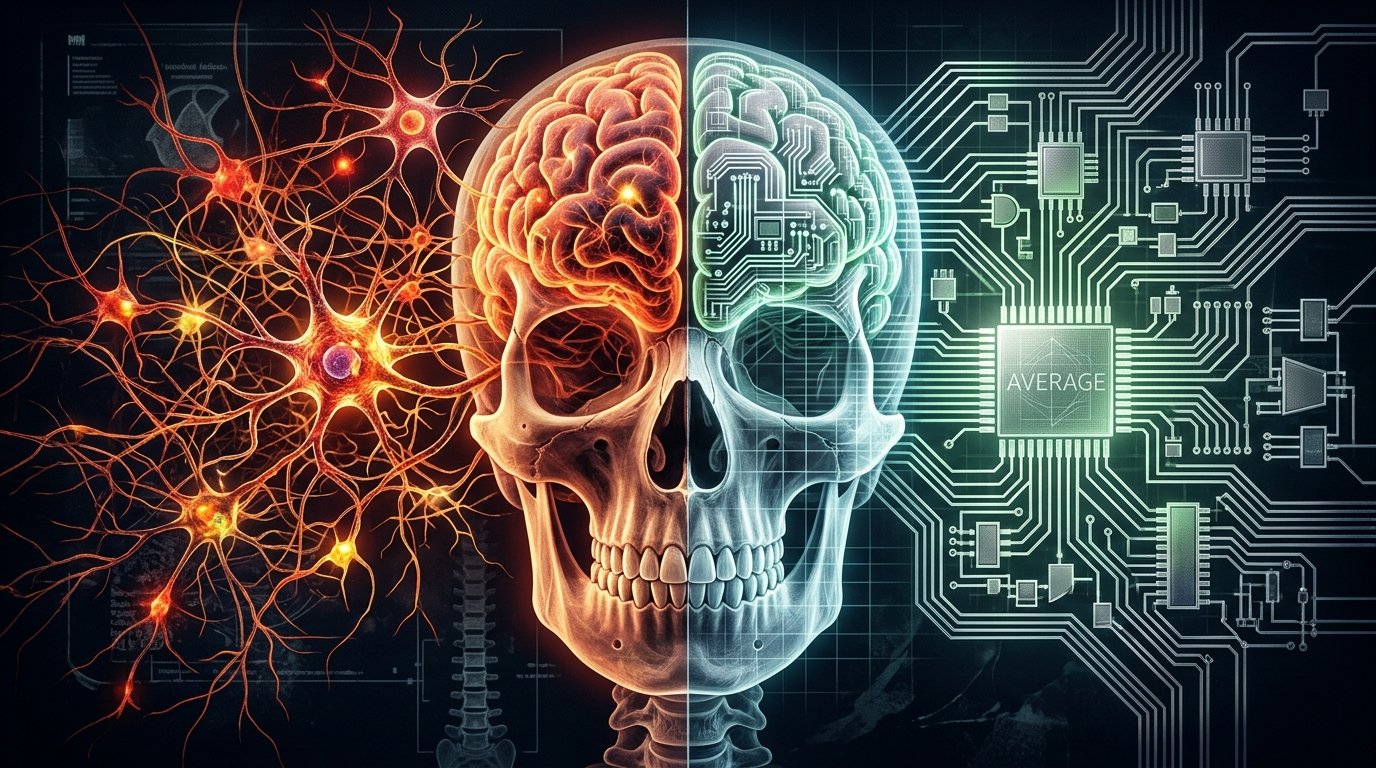
A 2025 meta-analysis of over 8,200 participants revealed a troubling paradox: while generative AI makes individuals feel more creative, it systematically erodes the one thing that matters most—original diversity.
You reach for ChatGPT to defeat the blank page. It works. The ideas flow. But look closer. Those ideas share the same sentence structures, use the same buzzwords, and follow the same predictable arcs. You are not alone in this trap.
Your Creativity Is Likely Becoming A Commodity
Ask an AI tool for ten marketing slogans. Then ask a colleague to do the same with the same prompt. Compare them side by side. Studies confirm that AI-generated outputs converge toward a narrow center, creating what researchers call the “LLM creativity paradox.” The outputs feel novel in isolation but collapse into sameness when compared.
The real scary part? You stop noticing the repetition. The algorithm trains you to accept its patterns as normal.
The “Creative Scar” You Can’t See
Researchers recently identified a phenomenon called the creative scar. Here is how it works. When you use AI, your output improves immediately. But once you stop using the tool, your unaided creativity crashes below its original baseline. Even worse, the content homogeneity induced by AI keeps climbing for months after you stop.
You are borrowing creative ability you do not actually absorb. The AI does the heavy lifting. Your muscles atrophy. When the tool disappears, you have nothing left to fall back on.
The Collective Novelty Problem No One Is Talking About
Strategy leaders frequently ask how to maintain brand voice during AI adoption. The answer is unsettling. AI boosts the least creative people the most while stealing from the most innovative outliers. In controlled studies, writers with low natural ability saw huge gains from AI collaboration. But the top 10% of creative individuals added nothing from the tool and the overall pool of ideas actually lost its sharp edge.
Your best people are being flattened to the average. Your average people are being elevated to a higher average. But the true breakthroughs only come from the edges.
Fluency Is Not Flexibility
Most people mistake high output for high creativity. AI is phenomenal at fluency. It generates hundreds of variations instantly. But flexibility, the ability to pivot categories and break conceptual frameworks, remains a uniquely human strength. During testing, researchers analyzed 600 humans against 12,000 AI ideas. The AI crushed the volume metrics. But the humans crushed true divergence and abstraction.
If your workflow consists of accepting the first three AI outputs, you are not creating. You are curating a machine’s safest bet.
How To Use AI Without Losing Your Edge
The research does not demand a Luddite rebellion. It demands discipline. Use AI as a divergent trash generator. Ask it to give you terrible ideas, boring ideas, ideas that break its own rules. Then turn off the screen. Walk away. Let your human brain rebuke the machine’s suggestions.
Never outsource the final judgment call. The crown jewel you cannot give away is your discomfort. AI will always offer a comfortable, average answer. Your job is to hate that answer enough to find a better one.
Guard your friction. The struggle to retrieve a word, the hours spent staring at a problem, the false starts and dead ends: that is not inefficiency. That is the forge of original thought. Outsource that, and you outsource your own voice.
Your Voice Is The Only Unscalable Asset
Every brand is gaining access to the same models. The prompts become public. The outputs homogenize. In a sea of AI-generated mediocrity, the only asset that remains truly scarce is your specific, flawed, unpredictable human weirdness.
Do not let the machine sanitize it.
Frequently Asked Questions (FAQs)
Q1: Does AI actually kill creativity or just change how we work?
Recent research shows AI gradually erodes cognitive diversity and can leave a "creative scar" when removed, but it does not have to kill creativity if used as a sparring partner rather than a replacement.
Q2: Why does AI make creative work feel "soulless" to so many users?
Approximately 78% of creatives report that AI-assisted work feels empty because it lacks the friction, struggle, and intentional imperfection that human audiences subconsciously recognize as authentic.
Q3: Can I train myself to avoid losing my creative edge while using AI?
Yes. Use AI for low-stakes divergent brainstorming only. Always rewrite outputs in your own voice. Maintain daily non-assisted creative practice. Treat AI as an intern, not a mentor.
Q4: What is the "creative scar" exactly?
A term from a 2025 Technology in Society study describing how over-reliance on generative AI causes lasting damage: boosted creativity disappears when AI is removed, but the homogenized thinking pattern remains visibly entrenched for months.
Q5: Is it already too late to reverse the homogenization trend?
No. Individual habits matter more than market trends. The models train on public data, but your private, non-shared thought process remains untouched. Protect it. Use it. Distrust the average output.